
Quick Summary
This UHF gate reader comparison guide breaks down hardware performance across compact pedestal and high-gain directional systems to help properties achieve fast, secure, hands-free vehicle access control. Smart Choice Gate Repair Long Beach highlights that configuring passive EPC Gen2 windshield tags with downward-angled polarized antennas and safety detection loops ensures seamless gate triggering while preventing cross-lane false reads. Readers will understand how to evaluate UHF RFID against optical license plate recognition systems, resolve signal interference from metallized windshield glass, and select the ideal access control hardware for their site geometry.
UHF Gate Reader Comparison Guide: Faster Entry & Top Range
This uhf gate reader comparison guide covers how ultra-high frequency RFID hardware performs in real-world vehicle access control. Compact short-range readers are often deployed for narrow residential driveways, while commercial properties and gated communities depend on high-gain directional antennas, though actual read range and performance vary depending on reader power, tag sensitivity, antenna configuration, and the propagation environment.[1]
Selecting the right hardware comes down to site geometry, controller compatibility, and environmental conditions. Windshield materials, approach speeds, and environmental propagation conditions all affect range and signal consistency. This guide breaks down what to look for so you get reliable, hands-free gate operation without false reads or lane cross-talk.
Fast Answers for UHF Vehicle Access
UHF RFID gate readers bridge the gap between fast vehicle entry and perimeter security. Most installations use passive Gen2 UHF windshield tags, which pull power directly from the reader’s radio frequency signal and eliminate the need for battery replacements. Depending on the controller setup, as noted by Smart Choice Gate RepairLong Beach, these readers typically interface with access control panels using common communication protocols such as Wiegand or OSDP.[2]
Core Considerations for Reader Selection
UHF systems operate within the 860 to 960 MHz frequency range governed by ISO/IEC 18000-6C and EPC Gen2 standards. Field performance and actual read range vary based on reader power, tag sensitivity, antenna configuration, and the propagation environment rather than fixed maximum specifications.[3]
Environmental propagation conditions can affect range and signal consistency. Mounting an antenna too high or pointing it straight down an open street can also cause cross-lane reads, picking up vehicles that have no intention of entering. Proper tuning and polarization keep the RF beam confined to the approach lane.
Passive vs. Active UHF Readers: Range, Protocol, and Maintenance Tradeoffs
Choosing between passive and active systems comes down to maintenance tolerance, budget, and read range requirements. Passive tags cost very little per vehicle and last indefinitely, while active tags provide longer range at the cost of periodic battery changes.[5]
Passive EPC Gen2 Windshield Tags vs. Active Battery Tags
Passive EPC Gen2 tags reflect the reader signal using backscatter modulation. The reader transmits RF energy, powers the microchip in the tag, and reads the credential data. Because the tag has no internal battery, it can last the lifetime of the vehicle windshield. However, moving vehicles experience slightly shorter read ranges than parked ones, making antenna positioning important on faster approach driveways.
| Feature | Passive Gen2 Windshield Tags | Active Battery Tags |
|---|---|---|
| Effective Range | Varies based on reader power, tag sensitivity, antenna configuration, and propagation environment | Extended range depending on transmitter power and propagation environment |
| Power Source | Reader beam backscatter (No battery) | Internal tag battery |
| Lifecycle Cost | Low cost per vehicle; inexpensive adhesive tags | Higher initial cost and recurring tag replacement fees |
| Weather Durability | Protected inside windshield; headlamp tags for metal glass | Enclosed fob; battery degrades in extreme heat or cold |
Integration Standards: Wiegand vs. OSDP Protocols
Gate operators and readers typically connect to access control boards using standard protocols such as Wiegand or OSDP (Open Supervised Device Protocol), depending on site requirements for wiring infrastructure, supervisory capabilities, and controller support.
Leading UHF Gate Reader Categories Compared: Performance, Range, and Build Quality
Need uhf gate reader comparison guide?
We’re available now — call for a fast, free estimate.
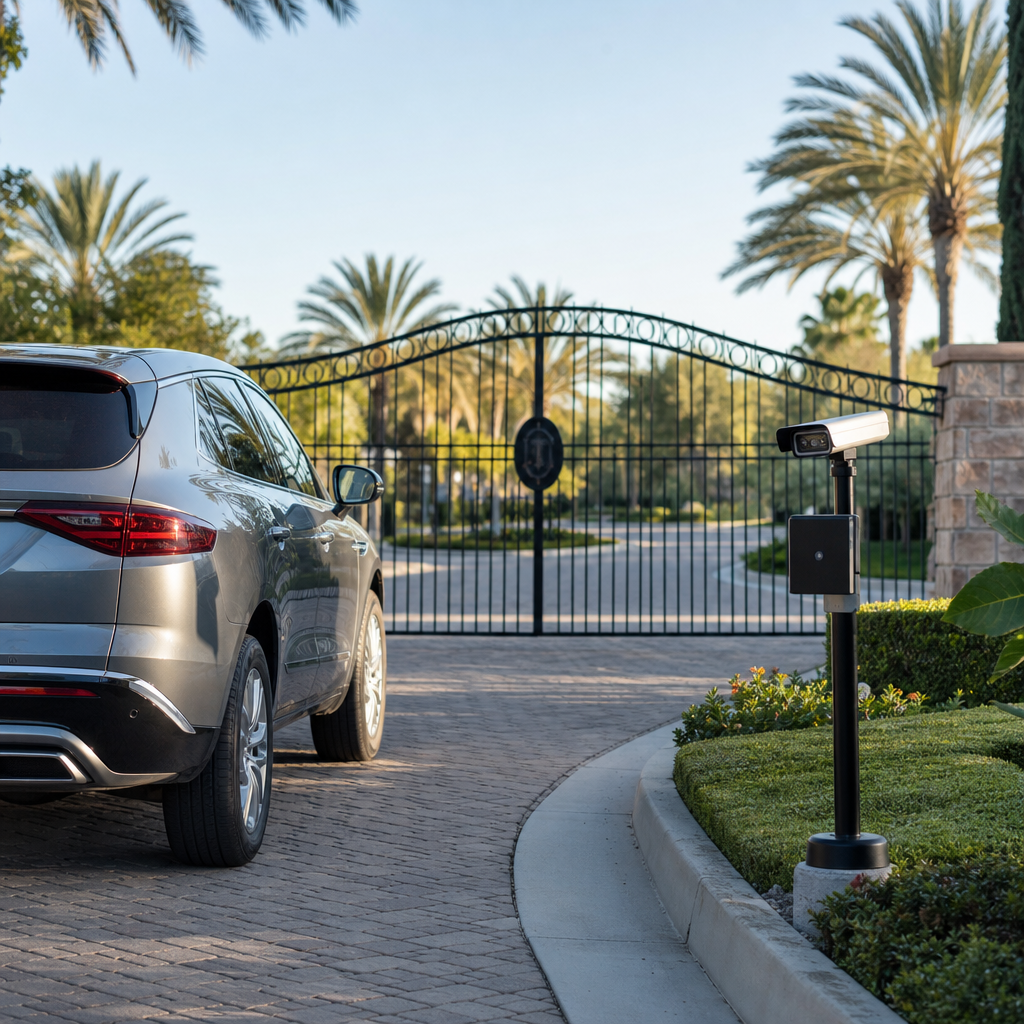
According to Smart Choice Gate RepairLong Beach, evaluating an RFID reader for driveway gates requires matching the antenna pattern to your driveway layout while ensuring the hardware can handle moisture, dust, and temperature swings.[4]
Comparing Compact vs. High-Gain Directional Readers
Readers are designed for different driveway profiles. Compact readers work best where vehicles come to a complete stop at a pedestal, while long-range directional readers clear moving traffic through automated slide, swing, or barrier gates.
| Hardware Category | Compact UHF Pedestal Readers | Long-Range Gen2 Directional Readers |
|---|---|---|
| Effective Range | Short range; varies by reader power, tag sensitivity, antenna configuration, and propagation environment | Extended range; varies by reader power, tag sensitivity, antenna configuration, and propagation environment |
| Best Application | Single-lane residential driveways, guard booths | Commercial parking, HOA communities, rapid access gates |
| Weather Protection | IP65 to IP67 rated enclosures | IP66 to IP67 rated, UV-stabilized radomes |
| Output Options | Standard access control interfaces (e.g., Wiegand, OSDP) | Standard access control and network interfaces (e.g., Wiegand, OSDP, TCP/IP, Relay Output) |
| Beam Adjustment | Fixed circular polarization | Adjustable gain, narrow linear or circular patterns |
Environmental Factors and Antenna Tuning
Environmental propagation conditions can affect range and signal capture. Using circular polarized antennas reduces tag orientation errors, while setting precise output power prevents the reader from triggering the gate when authorized vehicles simply drive past on the adjacent road.
UHF RFID vs. License Plate Readers (LPR): Which System Fits Your Gate?
UHF RFID uses radio communication to verify an internal credential, while License Plate Recognition (LPR) cameras use optical character recognition to read exterior plates. Many properties debate which system provides better access control.
Speed, Accuracy, and Environmental Reliability
LPR systems read standard vehicle plates without requiring owners to apply physical stickers. However, optical cameras can be vulnerable to visual factors such as heavy fog, headlamp glare, road dirt, bent plates, and low-light conditions. In comparison, UHF RFID is generally less susceptible to visual obstructions and lighting conditions, although environmental propagation conditions can still affect RF range.
| Operational Factor | Passive UHF RFID | License Plate Recognition (LPR) |
|---|---|---|
| Weather Sensitivity | Less sensitive to visual and lighting conditions, though environmental propagation conditions affect range | Subject to degradation from dense fog, glare, heavy rain, or dirty lenses |
| Credential Requirement | Windshield tag, hangtag, or headlamp sticker | Physical, clean license plate |
| Maintenance Burden | Low once tuned; check connections annually | Frequent lens cleaning and lighting adjustments |
| Primary Use Case | Authorized residents, tenants, and fleet vehicles | Visitor tracking, audit logs, and guest management |
For high-traffic gates, a hybrid setup often works best: UHF RFID handles fast, automated entry for authorized residents, while an LPR camera logs visitor entries at the secondary intercom lane.
Selecting and Implementing UHF Gate Access Systems
A reliable UHF gate setup, as highlighted by Smart Choice Gate RepairLong Beach, requires careful planning around physical mounting, safety loops, and wiring infrastructure.
Installation Best Practices
- Antenna Elevation and Angle: Mount directional readers 8 to 10 feet high, angled downward at roughly 15 to 30 degrees toward the vehicle approach zone. This creates a distinct read bubble and prevents reading vehicles in opposite lanes.
- Integration with Safety Devices: Wire reader outputs in series with vehicle detection ground loops so the gate only triggers when a car is physically present on the approach loop.
- Surge and Weatherproofing: Use outdoor-rated, shielded cabling with drip loops, silicone-sealed conduit entries, and grounded surge suppressors to protect control electronics from moisture and electrical spikes.
Frequently Asked Questions About UHF Gate Readers
How do vehicle features and window tints affect reader performance?
Factory-installed metallized windshields, infrared-reflective solar glass, and heavy aftermarket metallic tints block UHF radio signals. If a vehicle has metallized glass, interior windshield stickers will not read consistently. The solution is placing the tag in the vehicle’s “cutout” area (often behind the rearview mirror) or using exterior headlamp or front bumper license plate tags.
What factors determine UHF gate reader range and performance?
Read range and overall performance vary depending on reader power, tag sensitivity, antenna configuration, and the propagation environment. Compact pedestal units are typically configured for shorter distances, whereas high-gain directional systems can achieve longer read distances under proper alignment. Fine-tuning power output ensures the gate opens smoothly before the car arrives without picking up cross-traffic.
Need uhf gate reader comparison guide?
We’re available now — call for a fast, free estimate.
Sources
- [PDF] UHF RFID Tag Characterization: Overview and State-of-the-Art – people.ece.uw.edu (2011)
- [PDF] An Experimental Study on Continuous Scanning with Mobile Reader … – cs.wm.edu (2015)
- An Empirical Study of UHF RFID Performance – pages.cs.wisc.edu (2005)
- SIMULATION AND ANALYSIS OF RFID LOCALIZATION ALGORITHMS – etd.ohiolink.edu (2006)
- Adopter Spending on UHF RFID Market to Surpass US$10 … – abiresearch.com (2030)
Related reading: Rfid Gate Reader Vs Barcode Scanner | Call Now-10% Off | Same-Day Service | Free Estimate
Related reading: Comparing Rfid Based Gate Control System Options – 10% Off & Free Estimate – Same-Day Service
Related reading: Rfid Gate Control Pros and Cons | 10% Off & Free Estimate | Same-Day Service
Frequently Asked Questions
When should a facility choose OSDP over Wiegand protocol for UHF gate readers?
Facilities should upgrade to OSDP (Open Supervised Device Protocol) when they require bidirectional reader communication, encrypted credential transmission, and tamper monitoring over longer wiring distances. Smart Choice Gate Repair Long Beach installs OSDP-compatible UHF readers to provide high-security commercial sites with real-time hardware diagnostics and protection against data interception.
How do you prevent signal cross-talk between adjacent multi-lane UHF gate readers?
Preventing adjacent lane interference requires isolating RF channels, using directional linear antennas, and wiring readers in series with in-ground vehicle presence loops. Technicians from Smart Choice Gate Repair Long Beach precisely calibrate antenna output power and downward tilt angles so credentials only trigger the gate when a car sits directly in its assigned lane.
What tag options work best for vehicles with metallized or solar-reflective windshields?
If metallic tint or UV-blocking glass impedes UHF signals, properties can deploy exterior headlamp stickers, front bumper-mounted transponders, or standard tags placed within the vehicle rearview mirror cutout area. Smart Choice Gate Repair Long Beach tests site vehicle fleets and supplies durable, weather-sealed exterior UHF credentials to maintain seamless entry without signal loss.
About the author
 |
Rachel Lin Rachel Lin is a former property management consultant with over six years of experience managing residential and commercial facilities in Southern California. She holds a BA in Business Administration from California State University, Long Beach. Her writing focuses on practical solutions for property security and access control, with a specialized interest in automated gate systems and emergency repair protocols. |