
Quick Summary
This guide explains the complete technical process of how an RFID automatic gate operates to deliver fast, secure access for residential and commercial properties. The system functions through a rapid, four-step sequence where an antenna emits electromagnetic waves, captures vehicle transponder credentials, authenticates permissions via an access controller, and triggers the electromechanical gate motor. Readers will gain a clear understanding of RFID hardware standards and can rely on Smart Choice Gate Repair Long Beach for professional installation, credential programming, and system troubleshooting.
How Does an RFID Automatic Gate Operate for Fast Access
When you approach an automated entrance with an RFID system, the access sequence is designed to be seamless: your vehicle gets within range, the tag is read, and the gate opens. Behind that movement is a coordinated sequence between a reader, an access controller, and an electromechanical gate motor.
Here is a step-by-step breakdown of how an RFID automatic gate operates, from the initial wireless signal to gate actuation.
How an RFID Automatic Gate Operates: Quick Summary
Quick Summary: An RFID automatic gate operates through a verified core flow: a reader obtains the tag ID using electromagnetic waves, the access controller checks authorization against its database, and the motor opens the gate if access is granted.[1]
If a tag is unreadable or unauthorized, the gate remains closed to maintain access control.
Key Takeaways for Property Owners
In general RFID systems, readers can scan tags from a range of about 10 to 20 feet under ideal conditions, as noted in reports by the U.S. Government Accountability Office (GAO). The entry sequence follows three primary stages:[5]
- Interrogation: The reader broadcasts electromagnetic waves based on general RFID standards, such as the ISO/IEC 18000 series, to interact with the transponder.
- Authentication: The transponder transmits its unique credential back to the reader, which relays the data to the access controller to verify permissions.
- Actuation: If the controller validates the tag ID, it signals the gate motor to open the entrance.
What You Need for a Complete RFID Gate Access System
A reliable RFID gate access setup relies on key electronic and mechanical components working together to identify vehicles and manage access.
Core Hardware Components
In general RFID applications, systems use ultra-high frequency (UHF) components under ISO/IEC 18000 standards to read tags from 10 to 20 feet away, in contrast to short-range proximity systems such as ISO/IEC 14443 standards described by the National Institute of Standards and Technology (NIST).[3]
In a single experimental study by Etflin (2025), a specific automated RFID gate control system achieved 100 percent recognition accuracy with an average response time of 1.42 seconds from tag scan to motor activation. A standard system includes:[4]
- RFID Reader and Antenna: Emits electromagnetic waves and captures incoming transponder signals.
- Vehicle Transponders: Tags or stickers mounted on vehicles containing unique identification numbers.
- Access Controller: The processing unit that verifies received IDs against authorized credentials.
- Gate Motor: The mechanical operator that opens and closes the barrier.
Step 1: Emitting the Wireless Interrogation Signal
The access cycle begins when the RFID reader broadcasts electromagnetic waves into the driveway area to create an active interrogation zone.
Field Propagation and Tag Detection
When a vehicle enters the read range, the electromagnetic energy reaches the vehicle tag. In one study by Etflin (2025), an automated RFID setup recorded an average gate opening time of 4.85 seconds, compared with 7.12 seconds for manual access methods in that specific evaluation.[2]
Step 2: Capturing and Modulating the Transponder Data
Need how does an rfid automatic gate operate?
We’re available now — call for a fast, free estimate.
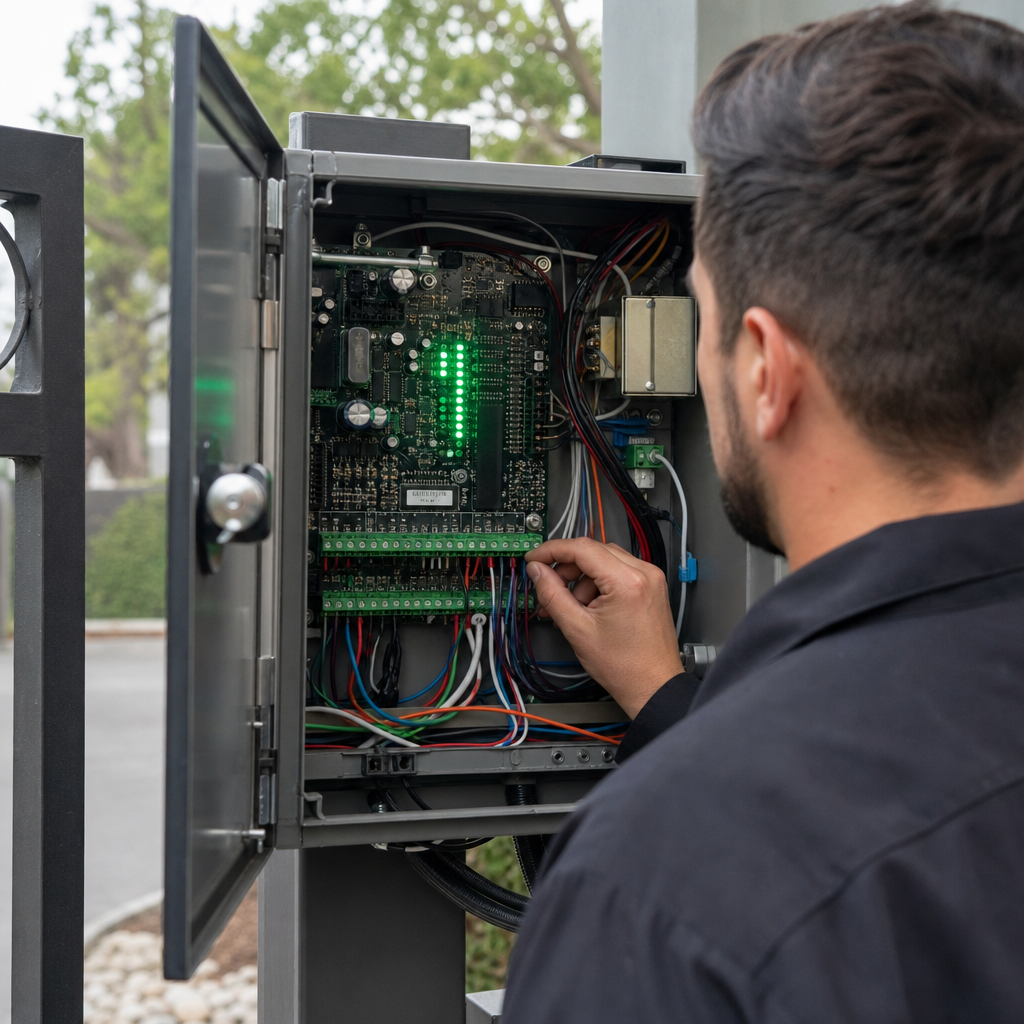
Once the reader’s electromagnetic wave reaches the passive transponder, the tag responds by transmitting its unique identifier back to the antenna via backscatter modulation.
| Feature | Passive Tag | Active Transponder |
|---|---|---|
| Power Source | Electromagnetic Wave Harvesting | Internal Battery |
| Typical RFID Range | About 10 to 20 ft (general RFID systems) | Extended range |
Step 3: Decoding the Credential Through the Access Controller
After the reader captures the returned signal, it decodes the transponder’s identifier and transmits the ID data to the access controller.
Controller Authorization Logic
The controller evaluates the received ID against its internal access permissions. If the credential is valid, the controller approves access and signals the gate operator.
Step 4: Opening the Gate
Upon receiving the authorization signal from the controller, the gate drive mechanism is triggered, as Smart Choice Gate RepairLong Beach technicians observe in automated setups. The motor engages to open the gate arm, slide gate, or swing gate.
Step 5: Logging and Resetting the Entrance
The controller logs the transaction, recording the credential ID and event timestamp. After the entry cycle is finished, the gate controller initiates closure to secure the entrance until the next authorized tag is scanned.
Frequently Asked Questions
How far away can an RFID reader scan a vehicle tag?
According to general RFID statements from the GAO, standard RFID systems can read tags from a range of about 10 to 20 feet under ideal conditions.
What is the core sequence of an RFID gate?
The core sequence consists of the reader obtaining the tag ID using electromagnetic waves, the controller checking authorization against its records, and the gate opening if access is granted.
Why might an RFID gate fail to detect a tag?
According to Smart Choice Gate RepairLong Beach, detection failures are commonly caused by physical obstructions between the tag and antenna, tag misalignment, or electromagnetic interference affecting the read area.
Need how does an rfid automatic gate operate?
We’re available now — call for a fast, free estimate.
Sources
- NIST SP 800-98, Guidelines for Securing Radio Frequency … – nvlpubs.nist.gov
- Research on Application of RFID in Smart Gate of Container Terminal – digitalcommons.georgefox.edu
- ISO/IEC 18000-63:2015 – iso.org (2015)
- [PDF] Impact Factor: 8.028 – ijarasem – ijarasem.com (2018)
- The Beginner's Guide to How RFID Systems Work – atlasrfidstore.com
Related reading: Evaluating Rfid Gate Access Solutions | 10% Off & Free Estimate | Same-Day Service
Related reading: Comparing Rfid Based Gate Control System Options – 10% Off & Free Estimate – Same-Day Service
Related reading: Rfid Gate Control Pros and Cons | 10% Off & Free Estimate | Same-Day Service
Frequently Asked Questions
Can metallic window tint or heated windshields interfere with RFID gate tag detection?
Yes, metallic film and embedded windshield heating elements can attenuate UHF radio waves, blocking the reader from energizing passive transponders. In these situations, Smart Choice Gate Repair Long Beach recommends installing exterior license plate or headlamp tags to maintain reliable read ranges.
How do RFID automatic gate systems prevent unauthorized vehicle tailgating?
RFID access controllers work in tandem with in-ground inductive safety loops to track vehicle passage precisely over the threshold. Once an authorized vehicle clears the loop detector, the controller triggers a rapid closing sequence to block trailing, unauthorized cars.
What happens to an automated RFID gate during a power outage?
Most professional RFID gate installations incorporate a dedicated battery backup unit to maintain reader, controller, and motor operation during electrical outages. Smart Choice Gate Repair Long Beach technicians can also configure fail-safe or manual mechanical overrides to ensure property access remains functional during extended blackouts.
About the author
 |
David Wallace David Wallace is a security systems specialist with over 10 years of experience in access control and gate automation. He holds a BS in Electrical Engineering from California State University, Long Beach, and has extensive experience designing and implementing secure entry solutions for both residential and commercial properties. David specializes in troubleshooting complex gate systems and providing practical advice on maintaining property security. |