
Quick Summary
Learning how to choose an rfid gate control system is critical for property owners seeking to eliminate entry bottlenecks, prevent false triggers, and protect gate operators from unnecessary wear. Smart Choice Gate Repair Long Beach emphasizes that optimal performance requires pairing Ultra-High Frequency readers with credential types suited to vehicle glass, backed by weather-resistant hardware rated for coastal environments. Readers will gain the technical clarity needed to evaluate power requirements, match controller communication protocols, and coordinate a dependable access control installation.
How to Choose an RFID Gate Control System for Reliable Access
Choosing an RFID gate control system comes down to matching reader frequency, credential formats, and physical environmental protections to your specific gate setup. A misconfigured system causes missed reads, tailgating, traffic backups at your driveway entrance, and unnecessary wear on your gate operator.
A functioning system allows authorized vehicles to enter smoothly while blocking unauthorized traffic. Achieving that reliability requires evaluating operating range, vehicle windshield materials, and physical site conditions before purchasing equipment.
Quick Summary: Key Decision Factors
To choose the right system, select Ultra-High Frequency (UHF) readers for vehicle gates requiring hands-free approach detection, or High Frequency (HF) for close-range pedestrian access. Match your credentials to your vehicles to avoid signal interference from metallized windshield glass, verify that your gate motor control board supports your reader’s output protocol, and specify weather-sealed, corrosion-resistant housings built for your local climate.[1]
What to Audit Before Selecting Hardware
Before ordering readers or tags, evaluate your entry layout, available electrical supply, and daily vehicle traffic. As technicians at Smart Choice Gate RepairLong Beach point out, checking these mechanical and electrical factors ensures your RFID gate access control system integrates cleanly with your gate motor without causing voltage drops, missed reads, or alignment failures.[2]
Power Supply and Approach Geometry
An automatic gate RFID scanner requires clean power and a direct line of sight to the approaching vehicle. Check these three items during your initial site evaluation:
- Auxiliary power capacity: Check whether your gate control board delivers enough dedicated 12VDC or 24VDC current to power a long range RFID gate reader, or if you need an isolated external power supply to prevent motor-start voltage dips.
- Approach geometry and setback: Measure the driveway curve and the distance from the curb to the gate. Vehicles need to square up directly within the reader’s transmission beam before reaching the physical swing or slide path.
- Control board enclosure: Confirm that the operator enclosure seals against moisture, dust, and coastal salt air to keep internal terminal blocks and relays clean.
Perimeter Security and Standards
National Institute of Standards and Technology (NIST) guidelines state that physical access controls should restrict access strictly to authorized personnel where RFID systems are deployed. Additionally, the U.S. Department of Homeland Security notes that sensitive RFID system components include physical boundaries such as fences, gates, walls, locked enclosures, and tamper-resistant hardware. Building physical security around your electronics keeps the entire entry secure.[3]
Step 1: Determine Read Range and Operating Frequency
Need how to choose an rfid gate control system?
We’re available now — call for a fast, free estimate.
Frequency dictates how far away your reader can detect a credential. Passive Ultra-High Frequency (UHF) handles automated vehicle lanes, while High Frequency (HF) fits walk-up pedestrian gates.
| Frequency Band | Standard Protocol | Effective Range | Primary Application |
|---|---|---|---|
| High Frequency (HF) | ISO/IEC 14443 | Up to 10 cm | Pedestrian turnstiles, walk-up gates, key fobs |
| High Frequency (HF) | ISO/IEC 15693 | Up to 50 cm | Pedestrian gates, proximity cards |
| Ultra-High Frequency (UHF) | EPCglobal Gen2 / ISO 18000-6 | Up to 10 metres | Long range RFID gate reader for vehicle lanes |
According to ISO/IEC standards, RFID security involves preventing unauthorized reading and modification of RFID data while protecting transmissions between the tag and reader. For vehicle entry, UHF systems operating on EPC Global Gen2 and ISO 18000-6 standards allow the gate to identify incoming cars up to 10 metres away, triggering the open cycle early enough that drivers do not need to brake to a complete stop.[5]
Shaping the Read Zone to Prevent False Triggers
A common mistake during installation is setting reader gain too high. If the antenna beam extends into the adjacent street or the exit lane, passing vehicles can trigger accidental gate cycles. Look for readers with adjustable RF power and directional patch antennas so you can restrict the detection cone strictly to the approach lane.
Step 2: Select the Right RFID Credential Format
Vehicle transponders come in several designs. Choosing the right one depends on vehicle construction and whether you need anti-passback or tamper-proof features.
| Feature | Windshield Sticker | Headlamp Tag | Dual-Frequency Fob |
|---|---|---|---|
| Mounting Location | Interior glass | Exterior headlamp lens | Key ring / handheld |
| Bypasses Metallic Glass | No | Yes | Yes (if presented manually) |
| Transfer Protection | Tamper-evident break lines | Destructive adhesive | Transferable |
| Pedestrian Gate Use | No | No | Yes (HF and UHF combined) |
Handling Metallic Windshield Attenuation
Many modern vehicles with metallic window films or metallized glass can attenuate UHF radio signals and reduce read range. If your property serves vehicles with metallized glass, use exterior headlamp tags or dual-frequency key fobs to maintain consistent read distances.
Step 3: Evaluate Weatherproofing and Hardware Durability
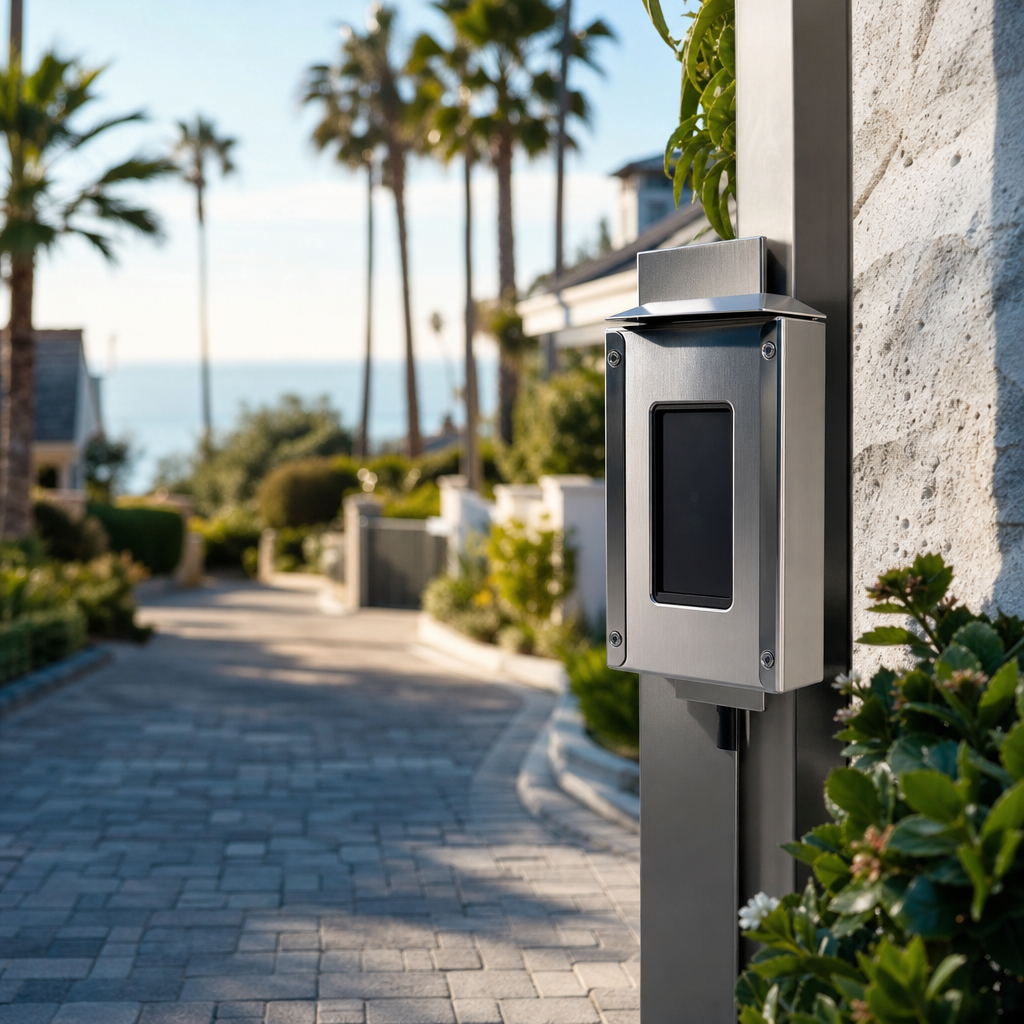
Gate electronics face tough operating conditions. In coastal regions, where specialists like Smart Choice Gate RepairLong Beach frequently service gate hardware, ocean breezes and morning marine layers carry salt mist that accelerates oxidation on antenna connectors, mounting brackets, and wiring terminals. In inland areas, severe temperature swings and heavy dust test hardware seals.
Select reader housings rated IP65 or higher with UV-stabilized polycarbonate radomes and stainless steel mounting hardware. Treat all field wire splices and coaxial cable connections with dielectric grease and heat-shrink tubing to prevent corrosion from degrading signal strength over time.
Step 4: Verify Opener and Access Controller Compatibility
Need how to choose an rfid gate control system?
We’re available now — call for a fast, free estimate.
An RFID reader detects credentials, but an access controller makes the security decision and signals the gate operator to open. Your reader’s output communication must match the controller’s input ports.[4]
Wiegand vs OSDP Protocols
The Open Supervised Device Protocol (OSDP) is a modern open-standard protocol using RS-485 and a secure channel for reader-to-controller communications.
Connecting to Gate Operators
Connect your access controller relay outputs directly to the gate operator’s dedicated open inputs. Keep access wiring isolated from safety inputs, such as photo eyes, safety edges, and reversing loops, so safety functions remain independent and active at all times.
Step 5: Estimate Equipment and Installation Costs
Installation costs vary widely and should be quoted site by site depending on whether you are retrofitting an existing gate or building a new entry from the ground up.
- Hardware: Costs depend on reader specifications, access controllers, and the quantity and type of vehicle credentials required.
- Infrastructure and Labor: Installing gooseneck pedestals, cutting asphalt for vehicle detector loops, and trenching conduit for power and data lines vary based on distance and site conditions.
- Ongoing Maintenance: Passive RFID tags require no internal batteries, keeping recurring costs focused on physical credential replacements and periodic gate hardware upkeep.
Step 6: Choose an Experienced Gate Access Installer
According to professional installers like Smart Choice Gate RepairLong Beach, installing an RFID vehicle access control system involves more than mounting an antenna to a post. Look for an installer who understands motor wiring, safety protocols, and radio frequency management.
A qualified technician will:
- Test reader beam angles on-site with different vehicle ride heights (from low sedans to lifted trucks).
- Calculate power draws to ensure the gate operator power supply does not drop voltage under load.
- Protect all physical enclosures and conduits against moisture, pests, and environmental corrosion.
Frequently Asked Questions
Can an RFID reader be added to an existing automated gate opener?
Yes. You can add a long-range RFID reader to an existing automated gate opener if the control board includes dry-contact open inputs or connects to an external access controller that supports standard interfaces like Wiegand or OSDP.
What is the difference between active and passive RFID gate readers?
Passive systems use tags powered directly by the reader’s radio frequency energy, making the tags inexpensive and maintenance-free. Active systems use battery-powered tags that transmit their own signal over longer ranges, but the tags cost more and require battery replacements.
How much does an RFID gate access control system cost to install?
Installation costs vary widely and should be quoted site by site based on electrical trenching distances, pedestal requirements, hardware selection, and whether the site needs a standalone access control panel.
What read range is best for residential vs commercial RFID gates?
Residential driveways generally benefit from a short-to-medium read range to avoid detecting vehicles parked nearby, while commercial facilities typically require a longer range to keep traffic moving smoothly through entry points.
Which type of RFID tag is best: windshield sticker, key fob, or headlamp tag?
Windshield stickers are best for standard passenger vehicles because they adhere directly to the glass and tear apart if moved. Headlamp tags work best on cars with metallic, infrared-reflective windshields that block interior radio signals. Dual-frequency fobs are best for residents who need one device for both the vehicle gate and pedestrian doors.
What happens if an RFID windshield tag stops reading?
If a tag stops reading, first check for physical damage, peeling, or interference from metallic window film. If the tag is intact, test the reader’s antenna alignment and inspect wire terminals for corrosion or moisture ingress.
Need how to choose an rfid gate control system?
We’re available now — call for a fast, free estimate.
Sources
- Physical Access Control Industry: 2026 Verified Stats – worldmetrics.org (2028)
- The Physical Access Control Business 2025 to 2030 – Memoori – memoori.com (2030)
- RFID Access Control Market Research Report 2033 – dataintelo.com (2033)
- RFID Access Control System Market Research Report 2034 – dataintelo.com (2034)
- Smart Access Control Reader Market Report | Global Forecast From … – dataintelo.com (2034)
Related reading: How Does an Rfid Automatic Gate Operate | 10% Off & Free Estimate | Same-Day Service
Related reading: Comparing Rfid Based Gate Control System Options – 10% Off & Free Estimate – Same-Day Service
Related reading: Rfid Gate Control Pros and Cons | 10% Off & Free Estimate | Same-Day Service
Frequently Asked Questions
How do you prevent vehicle tailgating with a long-range UHF RFID gate system?
To eliminate tailgating, technicians integrate directional in-ground vehicle loop detectors with an access controller configured for anti-passback and rapid-close sequencing. Smart Choice Gate Repair Long Beach optimizes antenna beam angles so the reader captures only the lead vehicle directly positioned in the approach zone.
Why is an isolated external power supply recommended for long-range RFID gate readers?
Automated gate operators draw heavy current surges when the motor starts, which can trigger voltage drops across shared auxiliary control board terminals. Using a dedicated, isolated 12VDC or 24VDC power supply ensures the RFID reader maintains steady voltage and avoids sudden reboots or missed credential scans.
How does coastal marine air impact RFID gate hardware longevity?
Salt mist and persistent humidity accelerate galvanic corrosion on coaxial connections, terminal blocks, and internal relays, leading to signal attenuation. Smart Choice Gate Repair Long Beach specifies IP65-rated enclosures, stainless steel fasteners, and dielectric-sealed wiring to preserve reader range and hardware life in coastal climates.
About the author
 |
David Wallace David Wallace is a security systems specialist with over 10 years of experience in access control and gate automation. He holds a BS in Electrical Engineering from California State University, Long Beach, and has extensive experience designing and implementing secure entry solutions for both residential and commercial properties. David specializes in troubleshooting complex gate systems and providing practical advice on maintaining property security. |