
Quick Summary
This guide explains how an RFID gate reader improves security at vehicle entry points by replacing easily shared keypad PINs and unsecured remotes with automated, encrypted credentials. As access control authority Smart Choice Gate Repair Long Beach highlights, pairing calibrated reader hardware with secure controllers prevents tag cloning, eliminates unauthorized perimeter access, and maintains precise entry audit trails. Readers will understand how core RFID components work together and can schedule a professional estimate to design a customized access control upgrade for their property.
How an RFID Gate Reader Improves Security – Fast Access Guide
An RFID gate reader can improve security when paired with encryption, authentication, and proper access controls. By replacing shared PIN codes and unmanaged credentials, an automated vehicle RFID system can reduce unauthorized access risks and provide better controlled entry while keeping access records organized.[3]
According to industry experts like Smart Choice Gate RepairLong Beach, implementing these systems effectively requires proper configuration of the access controller and reader hardware. When deployed with necessary safeguards, an RFID system helps manage perimeter access points and maintain traceable entry records.[5]
How an RFID Gate Reader Improves Security at Property Entry Points
An RFID gate access control system verifies approaching vehicles using radio frequency credentials. A reader antenna mounted near the driveway communicates with a vehicle credential, such as a windshield or headlamp tag. When paired with encryption and authentication, the system validates the credential identifier and signals the gate controller to grant entry.
Key Security Advantages Over Traditional Systems
- Reduced Risk of Shared Credentials: Dedicated vehicle tags reduce the risks associated with numeric keypad codes, which can be easily shared with unauthorized visitors.
- Precise Audit Trails: Entries can be logged with timestamps tied to specific credential profiles, providing a clear record of vehicle access events.
- Centralized Credential Revocation: Property managers can deactivate specific credentials in access management software without needing to change master access codes or rekey physical hardware.
How Readers Verify Credentials
According to the U.S. Department of Homeland Security, RFID deployments reduce unauthorized access risks when paired with hardware-level encryption and secure authentication methods. Without appropriate security controls, RFID data can be intercepted or read by compliant devices across open air.[2]
As experienced providers like Smart Choice Gate RepairLong Beach note, proper configuration is important during installation. Readers must be aligned and calibrated to ensure they query credentials in the intended entry area rather than detecting tags from vehicles in adjacent lanes.
Improving Perimeter Control and Reducing Unauthorized Access Risks
Standard manual entry methods, such as shared PINs or manual intercoms, can create vulnerabilities and delays at entry points. An automated RFID system supports better controlled entry by allowing authorized vehicles to be identified and verified on approach, reducing the risk of unauthorized entry.
However, the Government Accountability Office (GAO) has noted that without appropriate security controls, RFID signals can be read by compliant devices or intercepted across open air. To mitigate these risks, secure installations focus on the following core controls:
- Proper Reader Alignment and Calibration: Setting the reader field to cover the designated approach path.
- Access Controller Integration: Connecting reader inputs directly to a secure controller to authenticate credential transmissions.
- Encryption and Authentication Controls: Applying data encryption and mutual authentication protocols to protect transmissions from being intercepted or cloned.
RFID vs Keypads and Remotes: Security Comparison
Need how an rfid gate reader improves security?
We’re available now — call for a fast, free estimate.
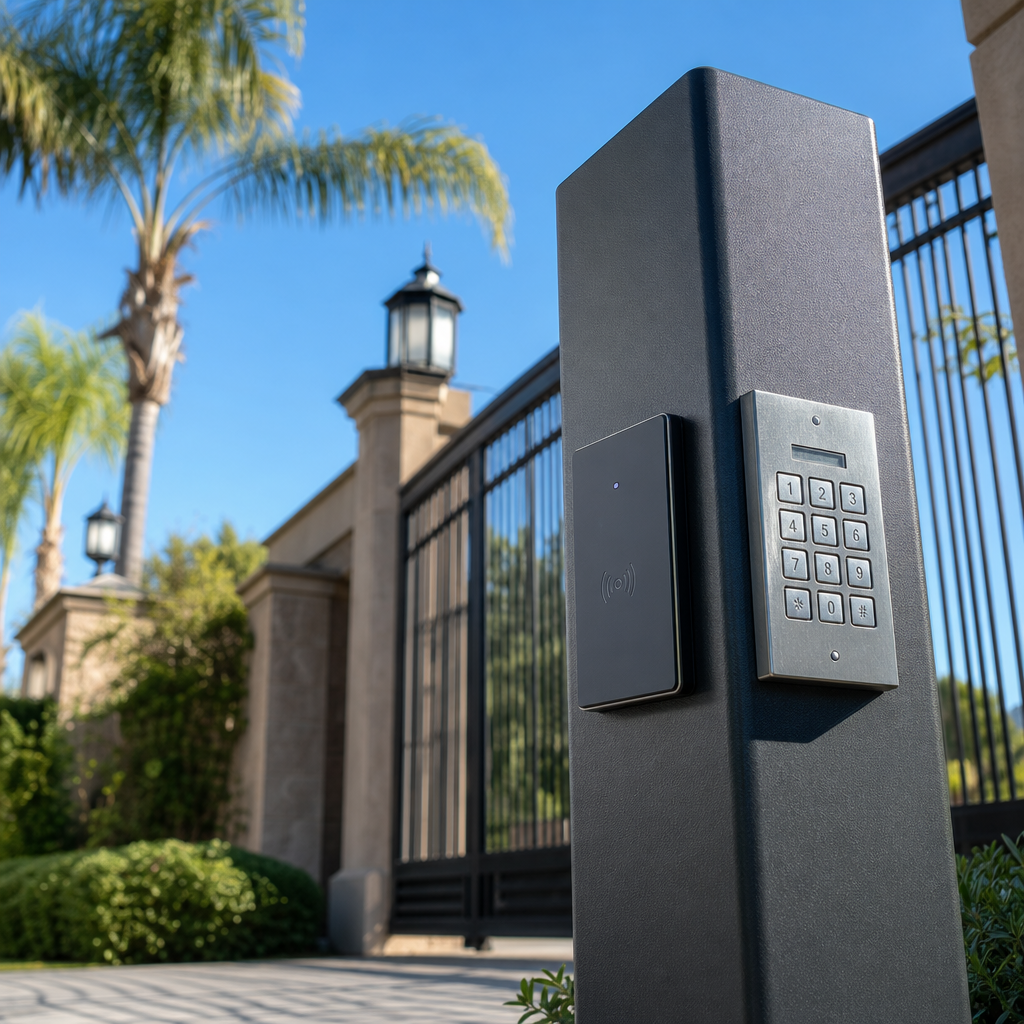
Using RFID for vehicle gate access can improve security over shared PINs or unsecured radio credentials. However, without safeguards such as encryption and authentication, RFID credentials can still be vulnerable to unauthorized reading, cloning, or interception.
| Security Feature | Keypad PIN | Standard Unsecured Remote | RFID with Security Controls |
|---|---|---|---|
| Resistance to Unauthorized Sharing | Low (PINs are easily shared) | Low (Physical remotes can be loaned) | Higher (Assigned to specific vehicle profiles) |
| Protection Against Interception / Cloning | None | Low (Vulnerable to signal capture) | High when paired with encryption and authentication |
| Entry Management | Manual entry required | Manual button press required | Controlled automated entry |
| Individual Credential Revocation | Requires master PIN reset | Requires manual code clearing | Centralized software deactivation |
Why Keypad Codes and Unsecured Remotes Fall Short
Keypad PINs often lose effectiveness over time because codes are easily shared with unauthorized individuals, requiring inconvenient system-wide resets to restore security. Unsecured remotes can also be misplaced, shared, or duplicated if they lack modern encryption standards.
Mitigating Interception and Cloning Risks
While unencrypted RFID signals can be intercepted or scanned by compliant readers, applying strong encryption protocols and authentication safeguards ensures that credential data cannot be easily skimmed or copied for unauthorized access.
System Components and Professional Installation
A vehicle RFID access control system typically relies on four primary components:
- RFID Reader: The antenna unit mounted near the entrance to read vehicle credentials.
- Access Controller: The central processing unit that authenticates credentials, enforces access rules, and signals the gate operator.
- Vehicle Credentials: Transponders or tags assigned to authorized vehicles.
- Vehicle Detection Sensors: Sensors integrated with the access system to manage vehicle detection and gate operation timing.
Protecting Electronics in Demanding Environments
Exterior electronic gate equipment must be protected against weather exposure and environmental wear. High humidity, moisture, and temperature fluctuations can impact unsealed electronics and wiring.
Standard installations recommended by specialists like Smart Choice Gate RepairLong Beach utilize weatherproof enclosures, sealed conduits, and surge protection to ensure that controllers and reader hardware remain reliable over time.
Frequently Asked Questions
How does an RFID gate reader verify vehicles?
The reader communicates via radio frequencies with an authorized vehicle tag. When paired with secure authentication methods and encryption, the system verifies the credential’s identity before signaling the gate controller to grant access.
Can RFID gate credentials be intercepted or cloned?
Without proper security safeguards, RFID data can be read by compliant readers or intercepted over open air. Using credentials and readers that support encryption and secure authentication reduces unauthorized access risks.[1]
What happens to an RFID gate system during a power outage?
Gate access systems can be equipped with backup battery supplies or configured to fail-safe modes to maintain controlled entry or safe egress during power interruptions.[4]
What is the difference between active and passive RFID credentials?
Passive tags do not have an internal battery and are powered by the signal emitted from the reader. Active tags contain an internal battery source to broadcast their signal over greater distances and require battery maintenance over time.
How does RFID compare to keypad entry for security?
RFID reduces the risks of unauthorized credential sharing associated with static PIN codes, enables individual credential revocation, and provides detailed entry logs when properly integrated with an access controller.
Need how an rfid gate reader improves security?
We’re available now — call for a fast, free estimate.
Sources
- The Use of RFID for Human Identity Verification – dhs.gov (2005)
- [PDF] The Use of RFID for Human Identity Verification – Homeland Security – dhs.gov (2006)
- Standalone RFID Access Control System with Data-Integrity Verification Capabilities – mdpi.com (2026)
- Enhancing Academic Security with RFID-Based Smart … – proceedings.unimal.ac.id (2025)
- RFID Applications and Security Review – pdfs.semanticscholar.org
Related reading: How Does Rfid Gate Control Work – 10% Off & Free Estimate – Same-Day Service
Related reading: Comparing Rfid Based Gate Control System Options – 10% Off & Free Estimate – Same-Day Service
Related reading: Rfid Gate Control Pros and Cons | 10% Off & Free Estimate | Same-Day Service
Frequently Asked Questions
Can an RFID reader be added to an existing automatic gate system?
Yes, modern RFID readers and access controllers can be retrofitted onto most existing residential and commercial gate operators. Smart Choice Gate Repair Long Beach can assess your existing motor and wiring during an on-site estimate to implement a compatible, secure access upgrade.
How do RFID gate readers prevent vehicles from tailgating?
RFID systems mitigate tailgating by pairing directional reader antennas with calibrated in-ground vehicle detection loops and rapid-close gate timers. This setup ensures the controller authenticates only one vehicle per cycle and quickly closes the barrier behind it.
How do tamper-resistant RFID vehicle tags prevent credential sharing?
Tamper-evident windshield decals feature fragile micro-circuitry that fractures and permanently disables the RFID chip if removed from the glass. This physical safeguard ensures that authorized access permissions cannot be transferred to unregistered vehicles.
About the author
 |
Rachel Lin Rachel Lin is a former property management consultant with over six years of experience managing residential and commercial facilities in Southern California. She holds a BA in Business Administration from California State University, Long Beach. Her writing focuses on practical solutions for property security and access control, with a specialized interest in automated gate systems and emergency repair protocols. |