Quick Summary
Perimeter security is rapidly advancing beyond standalone keypads as future trends in RFID gate control systems incorporate cloud administration, IoT connectivity, long-range UHF tracking, and mobile credential integration. As highlighted by Smart Choice Gate Repair Long Beach, achieving dependable automated access requires pairing sophisticated high-frequency or ultra-high-frequency RFID architecture with precise antenna calibration and well-maintained physical gate hardware. Readers will gain a clear understanding of emerging access technologies, enabling them to evaluate site-specific security needs and partner with regional specialists for professional gate modernization and installation.
Future Trends in RFID Gate Control Systems for Smarter Security
Automated gate security is shifting away from isolated standalone keypads and simple clickers. As property owners seek tighter perimeter defense and smoother entry, exploring future trends in RFID gate control systems highlights significant integrations that combine encrypted RFID credentials with mobile identities, cloud administration, IoT connectivity, and access analytics.[1]
Upgrading perimeter security requires more than mounting a scanner to a post. As technicians at Smart Choice Gate RepairLong Beach note, achieving reliable performance from radio-frequency hardware involves careful physical alignment and environmental considerations. For residential communities, estates, and commercial facilities, choosing an appropriate RFID architecture is key to maintaining dependable gate operation.[2] See also What Is an Rfid Gate Control System | Call Now-10% Off | Same-Day Service | Free Estimate.
Key Trends Shaping Modern RFID Gate Access
Traditional gate automation treated access readers as simple switches that sent a relay pulse to open a gate operator. Emerging system architectures explore treating the entrance as an interconnected access point within a broader security and property management network.[4]
In some implementations, high-frequency (HF) and ultra-high-frequency (UHF) readers are being paired with centralized platforms, offering property managers the potential for remote visibility and updated credential management.
Cloud Administration and Unified Access Platforms
Connected RFID systems can support centralized administration, event logging, and remote monitoring in some implementations. High-frequency (HF) RFID remains relevant to access control and secure identification. In connected deployments, centralized management can allow administrators to oversee credentials and review access activity across multiple entry points.[3]
Transitioning from Standalone Readers to Emerging IoT Integrations
Gate controllers are increasingly being explored for integration into broader IoT environments. Connecting access readers to networked controllers offers potential future opportunities for expanded system monitoring and centralized operational reporting.
Addressing Long-Range UHF RFID in Gate Environments
Need future trends in rfid gate control systems?
We’re available now — call for a fast, free estimate.
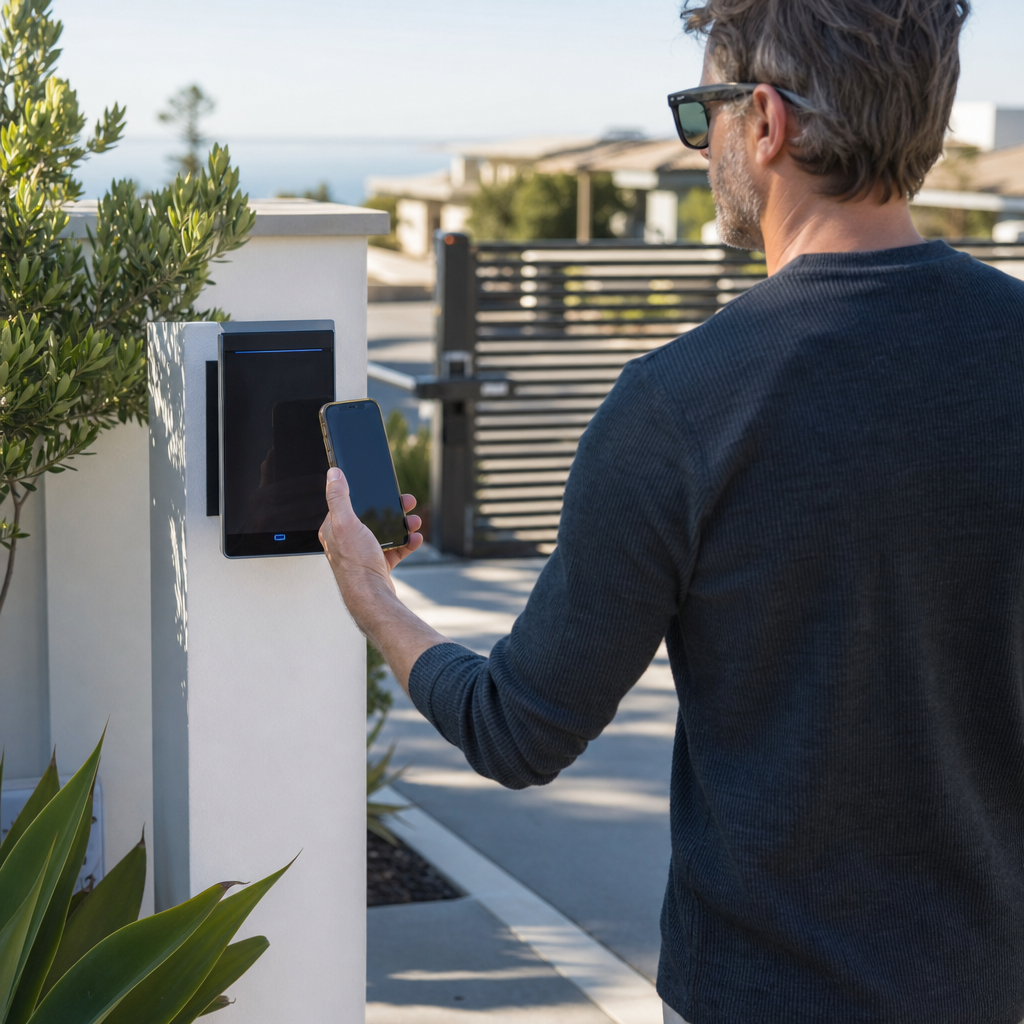
Many facilities consider ultra-high-frequency (UHF) RFID systems because UHF RFID supports longer-range and automated identification. However, utilizing longer read ranges introduces operational considerations that require careful site planning.[5]
Managing Read Fields and Vehicle Positioning
Because UHF signals can be detected across wider areas, readers may pick up transponders in adjacent lanes or approaching vehicles before they reach the gate threshold. Site designers treat antenna positioning, signal containment, and physical approach geometry as key engineering considerations requiring careful evaluation to ensure transponders register appropriately for the intended entry path.
Comparing Modern Gate Protocols: HF, UHF, and Mobile Credentials
As noted by Smart Choice Gate RepairLong Beach, choosing an RFID gate access technology involves evaluating reading characteristics and site requirements.
- High-Frequency (HF) RFID: HF technology remains relevant to access control and secure identification. Because HF systems require credentials to be presented close to the reader, they offer the potential for more localized reads when systems are properly configured.
- Ultra-High-Frequency (UHF) RFID: UHF RFID supports longer-range and automated identification, enabling hands-free access without requiring vehicles to stop in immediate proximity to the reader.
- Active vs. Passive RFID: Active RFID generally offers longer-range identification, while passive RFID commonly supports multi-meter applications.
- Mobile Credentials: Future systems may combine RFID credentials with mobile identities to provide additional entry options for users.
While technology adoption grows rapidly worldwide, real-world deployments highlight key differences between commercial fleet facilities that prioritize high-speed UHF tracking and residential communities that require hybrid HF and mobile access to manage resident vehicles and guest lanes.
Emerging Analytics and Perimeter Security Considerations
Perimeter access platforms continue to evolve as developers explore new methods for data analysis and credential verification.
Possible Integrations for Flow and Security Monitoring
In advanced access environments, potential integrations may include supplementary traffic sensors or video analytics to assist with vehicle tracking and event monitoring at the gate threshold, though these remain optional integrations rather than standard baseline features.
Pairing Access Software with Physical Hardware
Digital access controls depend fundamentally on the condition of the physical gate hardware. Long-term reliability requires pairing digital access controllers with properly balanced swing or slide gates, heavy-duty hinges, and dependable gate operators.
Professional technicians, such as those at Smart Choice Gate RepairLong Beach, assist with access control installation, operator maintenance, and gate repairs to ensure equipment is aligned, properly configured, and operating reliably.
Need future trends in rfid gate control systems?
We’re available now — call for a fast, free estimate.
Sources
- Radio Frequency Identification Technology Market (2025 – grandviewresearch.com (2030)
- RFID Market worth $30.47 billion by 2034 – prnewswire.com (2034)
- RFID Market Size, Share, Latest Trends & Growth Analysis … – marketsandmarkets.com (2034)
- RFID Label Market Research Report 2033 – marketintelo.com (2034)
- Asia Pacific RFID Market (2025-2030) – marketsandmarkets.com (2030)
Related reading: Uhf Gate Reader Explained | Call Now-10% Off | Same-Day Service | Free Estimate
Related reading: Comparing Rfid Based Gate Control System Options – 10% Off & Free Estimate – Same-Day Service
Related reading: Rfid Gate Control Pros and Cons | 10% Off & Free Estimate | Same-Day Service
Frequently Asked Questions
Can an existing automated gate operator be upgraded to support long-range UHF RFID and cloud access?
Yes, most commercial and residential gate operators can be retrofitted with networked UHF readers, cloud controllers, and mobile credential interfaces without replacing the physical gate. Smart Choice Gate Repair Long Beach evaluates your current operator mechanics and wiring to engineer a seamless hardware and access control modernization.
How do technicians prevent UHF RFID readers from falsely detecting vehicles in adjacent lanes?
Installers eliminate cross-lane interference through precise antenna beam shaping, signal power attenuation, and integration with directional ground loop sensors. Smart Choice Gate Repair Long Beach calibrates the read zone geometry so transponders only trigger the gate when a vehicle is directly in the designated entry path.
What are the advantages of combining RFID transponders with mobile digital credentials?
Hybrid access platforms allow permanent residents to enter seamlessly using hands-free windshield tags while granting temporary digital passes to guests via smartphone apps. Property managers can contact Smart Choice Gate Repair Long Beach for a free consultation and estimate on deploying multi-credential gate security architectures.
About the author
 |
David Wallace David Wallace is a security systems specialist with over 10 years of experience in access control and gate automation. He holds a BS in Electrical Engineering from California State University, Long Beach, and has extensive experience designing and implementing secure entry solutions for both residential and commercial properties. David specializes in troubleshooting complex gate systems and providing practical advice on maintaining property security. |