
Quick Summary
This guide to choosing RFID gate entry systems outlines how passive UHF and active transponder technologies eliminate traffic bottlenecks for residential communities and commercial facilities. Achieving reliable automated access requires balancing read ranges up to 10 metres, containing RF spill with directional antennas, and protecting low-voltage components from coastal moisture and corrosion. Smart Choice Gate Repair Long Beach provides expert guidance on hardware selection and weatherized installations, offering property owners free on-site estimates for customized gate automation.
Guide to Choosing RFID Gate Entry Systems for Fast Security
Morning traffic bottlenecks at an entry gate are usually caused by slow access controls. Handheld clickers run out of battery, keypads force drivers to stop and lean out into the rain or cold, and phone-based apps can lag on poor cellular connections. RFID technology solves this by letting vehicles roll through entry points without stopping, using passive windshield tags and directional overhead readers.[1]
As technical specialists at Smart Choice Gate RepairLong Beach note, getting an RFID system to work reliably takes more than just buying a high-powered reader. In coastal areas, moisture and salt air can affect radio signal performance and corrode exposed wiring and unsealed antenna housings. If an antenna is misaligned, its signal can spill into neighboring lanes and open gates for the wrong cars. This guide outlines practical advice on how RFID access hardware works, how to balance read range with perimeter security, and how to choose a setup for residential communities and commercial properties.[3]
How to Choose the Right RFID Gate Entry System Quickly
Choosing an RFID gate setup comes down to practical factors such as read distance requirements, daily traffic volume, and physical driveway layout. UHF is commonly used for vehicle gates, as UHF credentials can support gate entry up to about 10 metres without requiring tag battery replacements.
Active tags can provide longer range than passive tags for facilities where vehicles need to be identified from greater distances.
Core Selection Criteria for Residential and Commercial Gates
According to information security guidance from the New Zealand Government Communications Security Bureau, UHF credentials can operate at distances up to 10 metres. When evaluating hardware for your property, consider these practical factors:
- Credential Type: Adhesive windshield stickers and headlamp decals work well for permanent residents and staff because they are difficult to transfer between cars. Dual-frequency keycards or fobs can be used for sites where drivers also need pedestrian door access.
- RF Spill Containment: Long-range readers with broad broadcast fields can pick up tags from cars idling in turn lanes or parked near the gate. Using directional antennas or adjusting power settings helps restrict the read zone to the approach path.
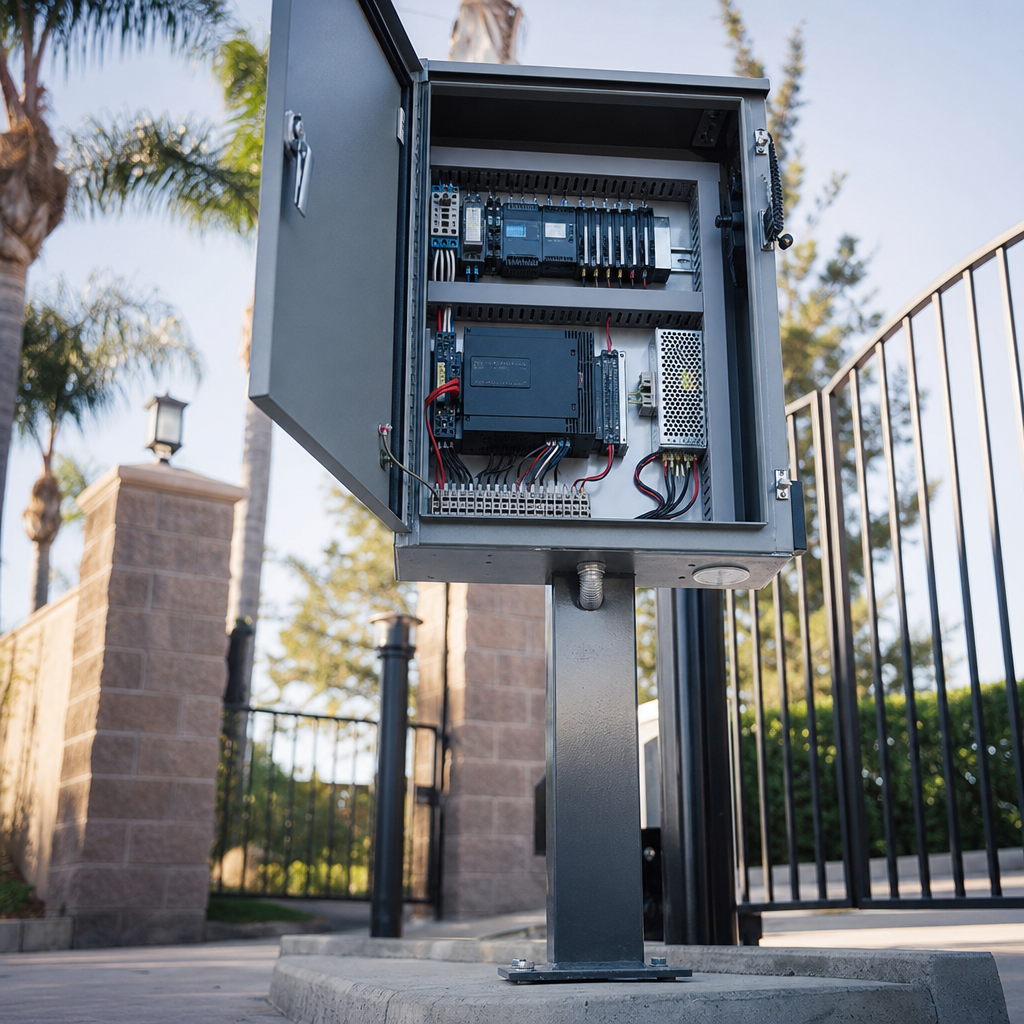
- Enclosure Ratings and Weatherproofing: Salt air and moisture can damage unsealed components. Readers and interface boards should be housed in protective, weatherproof enclosures with sealed cable glands.
- Controller Compatibility: Make sure the reader outputs standard protocols (such as Wiegand or OSDP) so it connects with your telephone entry panel or gate control board.
Cost and Planning Benchmarks
Hardware investments generally scale with the number of approach lanes, whether ground trenching is needed, and the complexity of the access controller. Retrofitting an existing gate with a single-lane passive reader and a local controller is relatively straightforward, while multi-lane commercial terminals with loop detectors, barrier arms, and management software require careful site layout and electrical coordination.
How Does an RFID Gate Entry System Work for Vehicles and Pedestrians?
An RFID gate system relies on three interconnected parts: a credential (tag, sticker, or card), an antenna/reader mounted near the driveway, and a gate access controller tied into the gate motor.[2]
- RF Interrogation: The reader broadcasts an electromagnetic field across the entry lane.
- Tag Response: When a vehicle drives into this field, a passive tag captures radio energy, powers its microchip, and transmits its identification data back to the reader.
- Credential Verification: The reader sends this data to the gate controller over a connection such as Wiegand or OSDP.
- Gate Actuation: The controller checks the ID against its database. If valid, it triggers a relay that signals the gate operator to open.
NIST states that access control systems use RFID to automatically check whether an individual is authorized to physically access a facility such as a gated campus or building, or logically access an information system. For properties handling sensitive operations, NIST also notes that RFID security guidance should address risks across applications, standards, and system components.[4]
Standard Frequency Bands
Selecting the proper frequency band determines operational read range and tag compatibility. New Zealand government information security standards categorize access control frequencies into distinct tiers:
| Band | Operating Frequency | Governing Standards & Range | Primary Gate Application |
|---|---|---|---|
| Low Frequency (LF) | 125 kHz | Short range | Pedestrian side gates, pool enclosures, key fobs |
| High Frequency (HF) | 13.56 MHz | ISO/IEC 14443 (up to 10 cm) ISO/IEC 15693 (up to 50 cm) |
Pedestrian turnstiles, smart identity cards, commercial buildings |
| Ultra-High Frequency (UHF) | UHF | EPC Gen2 / ISO 18000-6 (up to 10 metres) | Vehicle driveway gates, parking barrier arms, fleet logistics lanes |
Active vs. Passive RFID Gate Systems: Comparing Costs, Range, and Lifespan
Need guide to choosing rfid gate entry systems?
We’re available now — call for a fast, free estimate.
A key practical consideration for vehicle entry projects is choosing between passive and active RFID hardware.
Passive UHF tags contain no internal battery. They draw operating power from the radio waves transmitted by the reader. Because they have no moving or chemical parts, passive tags are generally durable and do not require battery replacements. UHF credentials can support gate entry up to about 10 metres under EPC Gen2 and ISO 18000-6 standards.
Active RFID systems use transponders with built-in batteries. Active tags can provide longer range than passive tags, though they require periodic battery replacement and carry higher credential costs.
| System Feature | Passive UHF Windshield Tags | Active Battery Transponders | Dual-Frequency Proximity Fobs |
|---|---|---|---|
| Operating Range | Up to 10 metres (EPC Gen2 / ISO 18000-6) | Longer range than passive | Up to 10 cm (ISO/IEC 14443) or 50 cm (ISO/IEC 15693) |
| Credential Cost | Lower cost per tag | Higher cost per transponder | Moderate cost |
| Maintenance Needs | No tag battery replacements needed | Requires periodic battery replacement | No tag battery replacements needed |
| Best Use Case | HOAs, apartment complexes, commercial lots | Facilities requiring extended read range | Mixed pedestrian gates and close-range vehicle access |
The U.S. Department of Homeland Security lists physical security elements for sensitive RFID systems, including fences, gates, walls, locked doors, turnstiles, surveillance cameras, tamper-resistant packaging, and security guards. Layering long-range RFID readers with physical perimeter barriers and safety induction loops helps ensure that only authorized, physically present vehicles trigger gate operations.
Managing RF Spill and Coastal Marine-Layer Signal Attenuation
Two technical challenges that can affect gate performance are radio frequency spill and environmental signal attenuation.
Preventing Adjacent-Lane Bleed and False Triggers
If an antenna broadcast is too broad or aimed incorrectly, it may read tags from nearby lanes or passing vehicles, causing unintended gate openings.
To help prevent this, consider these practical adjustments:
- Antenna Orientation: Angling the reader downward toward the driveway approach path prevents the beam from projecting toward cross-traffic.
- Power Attenuation: Adjusting reader transmit power narrows the radio footprint to cover the designated approach lane.
- Loop Detector Interlocks: Wiring the RFID reader through an in-ground inductive safety loop ensures the controller only processes tag reads when a vehicle is physically present.
Overcoming Coastal Moisture and Atmospheric Attenuation
Moisture in the air can attenuate radio signals, and coastal air carries salt that can lead to corrosion on exposed hardware.
According to field technicians at Smart Choice Gate RepairLong Beach, mitigating these conditions involves using weatherproof hardware enclosures, protective coatings or grease on wiring terminals, weather-rated conduit, and adjusting baseline power settings to maintain reliable vehicle detection in varying weather conditions.
RFID Gate Entry System Cost Breakdown: Hardware, Software, and Labor
Budgeting for an RFID gate installation involves three primary components: front-end hardware, back-end control infrastructure, and site labor.
1. Gate Readers and Credentials
- Passive UHF Readers: Vary in cost depending on range capabilities, enclosure ratings, and integrated antenna design.
- Passive Windshield Tags: Provide an economical credential option for residential communities and commercial facilities.
- Active Fleet Transponders: Involve higher per-unit hardware costs but offer extended range.
2. Controller Panels and Management Software
- Standalone Local Controllers: Store credentials directly on the board and do not require recurring software subscriptions, with updates managed on-site.
- Cloud-Managed Systems: Allow property managers to grant or revoke access, view entry logs, and configure schedules through a web interface.
3. Installation, Trenching, and Low-Voltage Wiring
Labor costs depend on driveway layout and existing infrastructure. If dedicated conduit and power lines already run to the gate post, installation is simpler. If the site requires cutting concrete, trenching for safety loops, or pouring new pedestals, installation labor forms a larger share of the total project budget.
Choosing the Right RFID Access Setup: Residential Communities vs. Commercial Facilities
Need guide to choosing rfid gate entry systems?
We’re available now — call for a fast, free estimate.
Driveway layout, user behavior, and traffic counts differ between residential neighborhoods and industrial commercial properties.
| Operational Metric | Residential HOAs & Subdivisions | Commercial Logistics & Industrial Yards |
|---|---|---|
| Primary Objective | Efficient resident throughput and guest management | Perimeter containment, audit tracking, and fleet control |
| Credential Preference | Windshield decals or headlamp tags | Active transponders or durable UHF tags |
| Secondary Integration | Telephone entry kiosks and visitor intercoms | Automated barrier arms and security guard controls |
| Vehicle Profiles | Passenger cars, SUVs, and light trucks | Trucks, flatbeds, and heavy equipment |
Residential Neighborhoods and Apartment Communities
For HOAs and multi-family complexes, the priority is smooth gate throughput. Windshield tags paired with UHF readers provide convenient entry. Combining RFID with an auxiliary telephone kiosk allows visitors and delivery drivers to request access without obstructing the primary vehicle lane.
Commercial Logistics, Warehouses, and Fleet Yards
Commercial yards handle a wide variety of vehicle sizes. In these layouts, single-height readers may not cover both low passenger vehicles and tall commercial cabs, so commercial installations often position antennas to cover multiple vehicle heights.
Why Professional Gate Technician Installation Matters
Access control readers are low-voltage devices connected to mechanical gate motors. As recommended by Smart Choice Gate RepairLong Beach, coordinating these systems requires proper installation and setup.
Common installation issues include running data cables too close to high-voltage lines, positioning antennas behind metal obstructions, or improperly coordinating open signals with safety loops.
A qualified gate automation specialist helps address:
- Antenna Beam Patterning: Orienting the directional field toward the approach lane while minimizing spill into adjacent areas.
- Safety Loop Coordination: Integrating inductive loops with the gate controller to ensure safe vehicle passage.
- Weather Protection: Using sealed weatherproof enclosures and protective measures against moisture and coastal air.
- Mechanical Alignment: Verifying that gate hardware moves smoothly when triggered by the access control system.
Frequently Asked Questions About RFID Gate Entry Systems
What is the typical read range for a vehicle RFID reader?
Passive UHF credentials can support gate entry up to about 10 metres under standards such as EPC Gen2 and ISO 18000-6. Active tags can provide longer range than passive tags depending on system design.
How does RFID gate access handle vehicle identification securely?
RFID access control systems transmit identification data from the credential to a controller, which verifies authorization against its database before granting access. NIST notes that RFID security guidance should address risks across applications, standards, and system components.[5]
What happens to the RFID gate system during a power outage?
Gate installations often incorporate battery backup systems or manual mechanical releases to maintain access or allow emergency operation during utility power outages.
Do RFID windshield tags work through coated glass windshields?
Certain vehicles have windshields with metallic tints or specialized coatings that can impede radio signals. For these vehicles, exterior tags, such as headlamp decals or bumper-mounted tags, can provide an alternative mounting option.
Can one RFID tag work for both my vehicle gate and building doors?
Yes. Dual-frequency credentials containing both a UHF antenna (for gate entry up to about 10 metres) and an HF or LF chip (such as 13.56 MHz HF or 125 kHz LF for short-range door readers) can allow users to access both vehicle gates and pedestrian doors with a single credential.
Need guide to choosing rfid gate entry systems?
We’re available now — call for a fast, free estimate.
Sources
- Access Control Market Size, Share, Trends & Research Report, 2031 – mordorintelligence.com (2031)
- RFID Access Control System Market Research Report 2034 – dataintelo.com (2034)
- Access Control System Market Trends, Share & Forecast … – polarismarketresearch.com (2034)
- Card-Based Access Control Systems Market Research Report 2034 – dataintelo.com (2034)
- RFID Access Control Market Research Report 2034 – marketintelo.com (2034)
Related reading: Rfid Gate Access Control System Benefits | Call Now-10% Off | Same-Day Service | Free Estimate
Related reading: Comparing Rfid Based Gate Control System Options – 10% Off & Free Estimate – Same-Day Service
Related reading: Rfid Gate Control Pros and Cons | 10% Off & Free Estimate | Same-Day Service
Frequently Asked Questions
How do you configure RFID readers to detect both low passenger cars and tall commercial trucks?
Commercial and mixed-use properties typically require mounting dual directional UHF antennas at staggered heights on a single pedestal to align with varying windshield and headlamp elevations. Smart Choice Gate Repair Long Beach evaluates vehicle profiles during a free on-site estimate to calculate precise mounting angles and avoid blind spots across different fleet types.
How do you prevent unauthorized tailgating through an RFID-automated gate?
Preventing tailgating involves integrating directional readers with dual inductive safety loops and fast-acting barrier operators that immediately drop after a verified vehicle clears the lane. Smart Choice Gate Repair Long Beach configures gate controllers with loop-detector interlocks so the system only registers a new RFID tag once the preceding vehicle has fully exited the threshold.
How often should outdoor RFID gate hardware be serviced in coastal environments?
Coastal RFID gate systems should receive preventive maintenance every six to twelve months to inspect weatherproof seals, clean marine grime from antenna covers, and refresh corrosion-inhibiting grease on low-voltage terminals. Smart Choice Gate Repair Long Beach provides specialized coastal tune-ups to calibrate antenna power and keep electronics protected against salt air.
About the author
 |
Rachel Lin Rachel Lin is a former property management consultant with over six years of experience managing residential and commercial facilities in Southern California. She holds a BA in Business Administration from California State University, Long Beach. Her writing focuses on practical solutions for property security and access control, with a specialized interest in automated gate systems and emergency repair protocols. |