
Quick Summary
An introduction to RFID gate entry systems explains how automated radio frequency technology provides secure, hands-free property access for residential and commercial locations. Smart Choice Gate Repair Long Beach highlights that optimal system performance depends on selecting the right frequency range, optimizing reader placement, and actively managing credential security. Readers will gain a clear understanding of core RFID hardware components, operational workflows, and best practices for integrating a reliable automated gate access solution.
Introduction to RFID Gate Entry Systems: Fast Secure Access
An RFID gate entry system is an automated access control system that uses radio frequency identification to detect credentials and control gate mechanisms. When an authorized RFID tag or card enters the detection zone, the system reads the credential, verifies its access permissions, and signals the gate operator to open, providing hands-free authorization.[1]
While RFID systems offer convenient hands-free authorization, an RFID credential functions as an access identifier rather than automatic proof of a person’s identity. According to technicians at Smart Choice Gate RepairLong Beach, operating an effective system requires attention to reader placement, interference, and overall access management.[4] See also What Is an Rfid Gate Control System | Call Now-10% Off | Same-Day Service | Free Estimate.
How RFID Gate Entry Systems Work
An RFID gate access system operates through communication between several core components: a reader, an RFID credential, an electronic controller, a gate operator, and, where applicable, access-management software and databases.
- Signal Broadcast: The reader emits a radio frequency field across the detection area.
- Tag Detection: When an RFID credential enters the range, it communicates its unique identifier back to the reader.
- Data Verification: The reader passes the credential data to the electronic controller, which checks authorization against stored rules or centralized access-management records.
- Gate Activation: If the credential is valid, the controller signals the gate operator to open the gate.
Core Components of an RFID Gate Access System
A complete RFID gate entry system typically includes the following components:
- RFID Reader: The device that emits radio signals and receives data from nearby credentials.
- RFID Credentials: Physical identifiers assigned to users or vehicles, such as cards, key fobs, and windshield tags.
- Electronic Controller: The unit that processes credential data, verifies permissions, and signals the gate operator.
- Gate Operator: The mechanical unit responsible for moving the physical gate.
- Database or Access-Management Software and Networking: Where applicable, connected software and databases used to manage access rules, handle lost or revoked credentials, and record audit logs.
RFID Frequency Categories and Read Range
Need introduction to rfid gate entry systems?
We’re available now — call for a fast, free estimate.
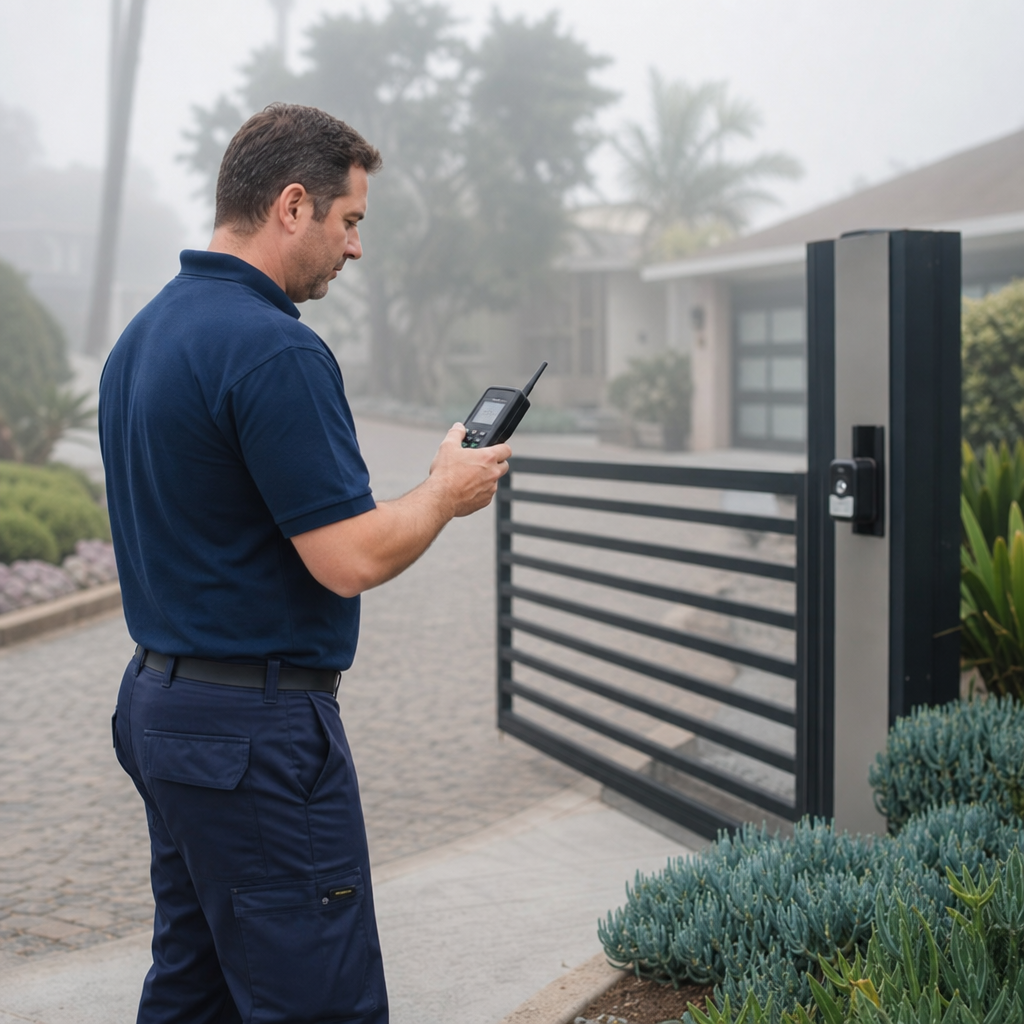
RFID systems operate across three primary frequency categories: low-frequency (LF), high-frequency (HF), and ultra-high-frequency (UHF). Frequency selection affects read range, performance across different physical environments, and the appropriate credential or application type.
| System Type | Typical Read Range | Key Considerations |
|---|---|---|
| Passive UHF RFID | About 4 to 10 meters | Powered by the reader’s signal; widely used for vehicle gate entry. |
| Active RFID | About 10 to 30 meters | Powered by an internal battery; provides extended detection range. |
In vehicle gate applications, passive UHF systems typically achieve read ranges of about 4 to 10 meters, whereas active systems generally read at about 10 to 30 meters. As noted by Smart Choice Gate RepairLong Beach, actual read performance depends on antenna placement, tag orientation, environmental interference, vehicle materials, and installation conditions.
System Considerations, Security, and Management
Properly implementing an RFID gate entry system requires addressing site layout, security policies, and administrative controls:
- Reader Placement and Interference: Reader placement and RF interference require careful attention during installation to ensure reliable credential detection and prevent unintended reads in adjacent areas.
- Credential Security and Identity Verification: An RFID credential should be treated as an access identifier rather than automatic proof of a person’s identity. Stronger systems can combine RFID credentials with additional authentication factors and centralized authorization records.
- Lost and Revoked Credentials: Access-management systems should allow administrators to quickly deactivate lost or revoked credentials to prevent unauthorized entry.
- Audit Logging and Integration: Access systems should maintain audit logging and integrate smoothly with the gate controller and broader access-management network.
Frequently Asked Questions About RFID Gate Entry Systems
What are the main advantages of an RFID gate entry system?
RFID systems provide hands-free authorization, allowing authorized vehicles or individuals to be verified and pass through gates without manual code entry.[3]
Does an RFID credential verify a person’s identity?
No. An RFID credential serves as an access identifier rather than automatic proof of a person’s identity. Higher-security environments may combine RFID with additional authentication factors.[5]
What factors affect RFID read range and performance?
Actual performance is influenced by frequency selection, whether tags are passive or active, antenna placement, tag orientation, interference, vehicle materials, and installation quality.[2]
How are permissions and lost credentials managed?
As Smart Choice Gate RepairLong Beach explains, access permissions, audit logs, and lost or revoked credentials are managed through the electronic controller and, where applicable, connected access-management software and central databases.
Need introduction to rfid gate entry systems?
We’re available now — call for a fast, free estimate.
Sources
- RAIN in Action 2026 chooses Madrid and reinforces … – therainalliance.org (2026)
- RFID 2026-2036: Forecasts, Players and Opportunities – IDTechEx – idtechex.com (2036)
- RFID timeline by IDTechEx – idtechex.com (2036)
- RFID Market Set to Reach US$23 Billion by 2036 – idtechex.com (2036)
- How Regional Differences Are Shaping the Future of … – idtechex.com (2025)
Related reading: Future Trends in Rfid Gate Control Systems – Call Now-10% Off – Same-Day Service – Free Estimate
Related reading: Comparing Rfid Based Gate Control System Options – 10% Off & Free Estimate – Same-Day Service
Related reading: Rfid Gate Control Pros and Cons | 10% Off & Free Estimate | Same-Day Service
Frequently Asked Questions
Can an RFID reader be retrofitted onto an existing automated gate system?
Yes, most standalone RFID readers and electronic controllers can be integrated directly with existing residential or commercial gate operators. Smart Choice Gate Repair Long Beach can inspect your current gate hardware to ensure voltage and controller compatibility without needing to replace the entire mechanical system.
Should I choose passive UHF or active RFID tags for vehicle entry?
Passive UHF tags are the standard, cost-effective choice for most vehicle gates because they require no internal batteries and provide dependable 4-to-10-meter detection ranges. Active RFID tags are typically reserved for specialized commercial facilities needing extended detection distances of up to 30 meters.
How do property managers disable a lost or stolen RFID gate credential?
Administrators can immediately delete or blacklist the specific credential's unique identifier within the electronic controller or access-management database. Once revoked in the system, the physical tag will no longer trigger the gate operator to open.
About the author
 |
Rachel Lin Rachel Lin is a former property management consultant with over six years of experience managing residential and commercial facilities in Southern California. She holds a BA in Business Administration from California State University, Long Beach. Her writing focuses on practical solutions for property security and access control, with a specialized interest in automated gate systems and emergency repair protocols. |