
Quick Summary
This fast guide explains how to evaluate whether a commercial RFID gate control system is the right investment for streamlining perimeter traffic and eliminating shared-PIN security risks. Commercial access specialists at Smart Choice Gate Repair Long Beach emphasize that long-range UHF RFID systems dramatically speed up vehicle throughput while requiring proactive credential management to prevent unauthorized access. Readers will understand operational factors like read range and controller compatibility, compare RFID against alternative entry technologies, and learn how to plan a tailored commercial gate installation.
Is an RFID Gate Control System Right for My Business? Fast Guide
Deciding if an RFID gate control system is right for your business comes down to vehicle volume, security demands, and how quickly traffic needs to clear your perimeter. For facilities managing high traffic or seeking to replace shared gate PINs, radio frequency identification (RFID) offers contactless authentication, automated authorization, and detailed event logging to streamline vehicle access.
The global RFID access control market continues to expand, projected to rise from $8.7 billion in 2025 to $14.9 billion by 2033. Facilities across industrial corridors, distribution hubs, and office parks are increasingly replacing mechanical locks and keypad pedestals with automated vehicle tags.[1]
Evaluating Commercial RFID Gate Systems: Rapid Assessment and Key Takeaways
An RFID vehicle gate system makes practical and economic sense if your facility processes recurring vehicle traffic and requires contactless authentication and an automated, timestamped log of entry events. For gated industrial yards, distribution depots, and multi-tenant commercial parks, hands-free readers help prevent traffic bottlenecks at the curb while managing access permissions.
Core Operational Criteria for RFID Gate Entry
Hardware accounts for the largest share of overall access control spending. Before committing capital to new equipment, evaluate three primary operational factors:
- Traffic volume and peak flow: Measure how many vehicles enter during shift changes or delivery windows. A long-range antenna authenticates vehicles without requiring drivers to stop and open their windows.
- Roster and vendor turnover: High driver or contractor turnover demands strict credential management. If your team does not regularly audit software permissions, unreturned vehicle decals can compromise perimeter control.
- Driveway geometry and read range: Confirm that your entryway provides enough straight approach distance for the UHF antenna to read the vehicle tag and complete the gate opening cycle before the bumper arrives.
Key Takeaways for Fast Facility Decisions
Market data from Dataintelo indicates strong ongoing adoption of RFID technology across enterprise environments through 2033. However, before investing, calculate your credential-loss threshold. In high-turnover environments where outside contractors come and go, unmonitored passive windshield tags can create an overlooked security risk. According to specialists at Smart Choice Gate RepairLong Beach, pairing commercial-grade RFID hardware with strict software revocation protocols ensures your perimeter remains secure and access logs remain accurate.[3]
How Commercial RFID Vehicle Gate Entry Systems Work in Real Operations
Need is an rfid gate control system right for my business?
We’re available now — call for a fast, free estimate.
A commercial RFID gate system manages site access through radio frequency communication between an antenna reader and an authorized vehicle credential. When a tagged truck or employee vehicle approaches the entrance, the system authorizes entry automatically:
- Antenna Broadcast: A directional UHF (Ultra High Frequency) reader continuously monitors a designated detection zone extending 15 to 30 feet from the gate.
- Credential Response: The vehicle tag enters the field and transmits its identification number back to the reader.
- Access Verification: The central access controller checks the ID number against active schedules and permissions in the database.
- Gate Activation: Upon confirmation, the controller signals the gate motor relay, opening the slide, swing, or barrier gate without requiring the driver to stop.
Active vs Passive RFID Windshield Tags and Decals
Most commercial vehicle gates use passive UHF windshield stickers. These decals draw power directly from the reader’s radio signal, making them inexpensive and low-maintenance. Active tags rely on internal batteries and provide longer read ranges, which can be helpful for heavy mining equipment or specialized staging yards, but passive decals remain the practical standard for commercial fleets and employee parking.[5]
Long-Range Readers vs Standard Proximity Cards
Standard proximity cards force drivers to pull directly alongside a pedestal, roll down their window, and physically swipe or tap a reader. This creates delays and can lead to gate pedestal damage from vehicle mirrors. Long-range UHF readers identify vehicles while they are still in motion on the approach ramp, keeping delivery lanes clear and traffic moving steadily.
Controller Integration and Weather Protection
Market research shows that physical cards and decals continue to make up more than a third of the access control credential market in 2025. In outdoor environments with humidity or temperature fluctuations, commercial RFID readers utilize NEMA-rated, weather-sealed enclosures wired directly to commercial-duty control boards to prevent electronic faults and moisture damage.[2]
RFID vs Keypads, Keycards, and License Plate Recognition (LPR)
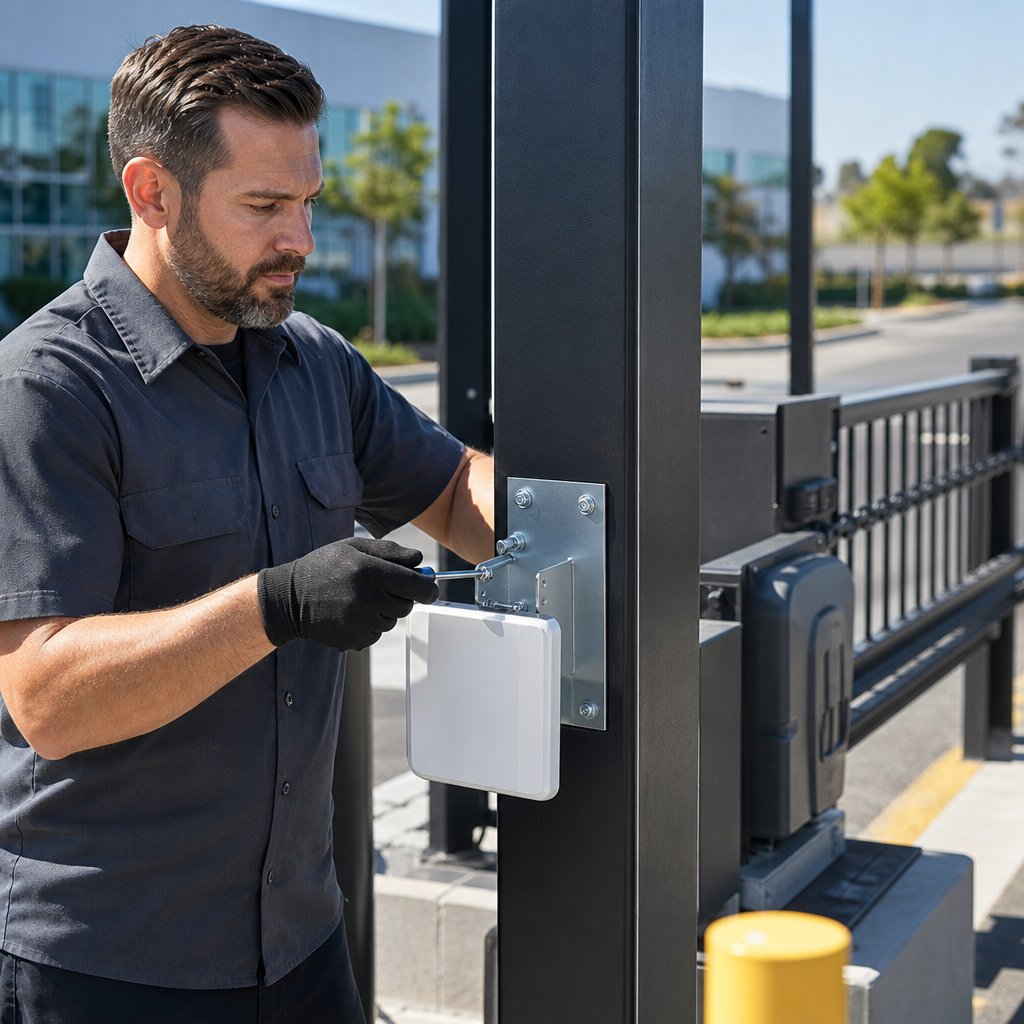
Choosing the right entry technology means weighing throughput speed, security integrity, and equipment reliability under operational conditions:
- Digital Keypads: Inexpensive to install, but PIN codes can be shared with unauthorized drivers, delivery couriers, and former employees, creating security gaps.
- Proximity Keycards: High credential security, but slower throughput because drivers must stop completely at a pedestal.
- License Plate Recognition (LPR): Completely contactless, but optical camera performance can be affected by heavy weather, glare, or dirty license plates.
- Long-Range RFID: Provides contactless authentication and automated authorization without relying on optical imaging, provided windshield tags are properly tracked in your database.
The High-Turnover Credential Loophole in Passive RFID Systems
The primary vulnerability with passive windshield decals occurs when facilities fail to track third-party vendors and temporary haulers. If a short-term contractor leaves your project with an active RFID decal stuck to their windshield, they retain access to your yard until an administrator manually revokes that specific credential in the management software. To keep your system secure, establish a policy that binds contractor credentials to firm expiration dates inside your access control dashboard.
Commercial RFID Gate Installation and Hardware Costs
Need is an rfid gate control system right for my business?
We’re available now — call for a fast, free estimate.
As technicians at Smart Choice Gate RepairLong Beach point out, total installation pricing depends heavily on your existing site layout, electrical access, trenching requirements, and reader specifications. Because hardware makes up nearly half of the total expense in commercial access deployments, choosing durable components built for industrial wear is essential.
Key Cost Components to Consider
- Commercial UHF Readers and Antennas: High-grade directional readers designed to reject interference from adjacent traffic lanes.
- Access Controller Panels: Multi-door or multi-gate controllers that manage user databases, event logs, and safety interlocks.
- Ground Safety Loops and Detectors: In-pavement induction loops that detect vehicle mass to prevent gates from closing prematurely on passing trucks.
- Cabling, Trenching, and Conduit: Saw-cutting asphalt and running high-grade conduit from the gate pedestal to the main facility network.
- User Credentials: Bulk orders of passive windshield decals or rear-view mirror hangtags.
Industry projections from Grand View Research show the broader RFID market reaching $62.3 billion by 2035, confirming steady manufacturing support and part availability for the next decade.[4]
Which Business Types Benefit Most from RFID Gate Access?
Facilities that experience high vehicle turnaround, manage dedicated fleets, or hold sensitive inventory benefit from contactless authentication, automated authorization, and event logging:
- Freight Terminals and Logistics Warehouses: Automated reader antennas allow line-haul trucks and delivery vans to pull directly into staging bays without manual check-ins at a guard shack.
- Commercial Office Parks: Employees enter without queuing, reducing vehicle congestion along perimeter access roads during shift changes.
- Municipal Depots and Utility Yards: Fleet trucks access fuel pumps and equipment depots with complete automated time and identity tracking in the access log.
- Residential Communities and HOA Properties: Reduces reliance on shared gate PINs and physical clickers across community entrances.
Commercial Gate Access FAQs: Cost, Timing, and Installation
Can RFID readers be retrofitted onto our existing automatic gate?
Yes. As noted by Smart Choice Gate RepairLong Beach, if your current gate operator controller board accepts standard 26-bit Wiegand or encrypted OSDP inputs, an RFID reader antenna and controller module can be integrated into your existing setup without replacing the motor.
How quickly can an RFID gate system be installed and operational?
Installation duration varies depending on whether the project is a retrofit onto an operational gate or requires extensive infrastructure work, such as new trenching, power runs, or ground loop sensor cuts.
What ongoing maintenance does an RFID commercial gate reader require?
To ensure uninterrupted gate operation, facilities should schedule regular preventative service focused on three areas:
- Ground Loop Recalibration: Routine tuning of vehicle presence detectors ensures the gate only closes once the vehicle has cleared the path.
- Enclosure and Seal Checks: Periodic inspection of NEMA electrical boxes prevents moisture and environmental debris from corroding sensitive terminal connections.
- Antenna Angle and Power Tuning: Periodic calibration of the antenna beam ensures the detection field does not pick up vehicles driving in adjacent lanes or public street traffic.
Need is an rfid gate control system right for my business?
We’re available now — call for a fast, free estimate.
Sources
- RFID Access Control Market Research Report 2033 – dataintelo.com (2033)
- RFID Access Control System Market Research Report 2034 – dataintelo.com (2034)
- Access Control Market Size, Share & Trends – marketsandmarkets.com (2030)
- RFID Market Size, Forecasts Report 2026-2035 – gminsights.com (2035)
- RFID 2026-2036: Forecasts, Players and Opportunities – IDTechEx – idtechex.com (2036)
Related reading: Uhf Gate Reader Comparison Guide – Call Now-10% Off – Same-Day Service – Free Estimate
Related reading: Comparing Rfid Based Gate Control System Options – 10% Off & Free Estimate – Same-Day Service
Related reading: Rfid Gate Control Pros and Cons | 10% Off & Free Estimate | Same-Day Service
Frequently Asked Questions
What happens if vehicles with metallic or solar-reflective windshields block passive RFID signals?
Specialized headlamp decals or exterior transponders mounted to front bumpers can replace standard windshield stickers on fleet vehicles equipped with signal-blocking UV coatings. Smart Choice Gate Repair Long Beach can test signal penetration across your commercial fleet during an on-site evaluation to ensure every vehicle registers reliably.
How can our facility prevent unauthorized vehicles from tailgating behind an RFID-authorized truck?
Facilities can eliminate tailgating by pairing RFID readers with fast-acting barrier arms and directional anti-tailgating ground loops that prompt rapid gate closure immediately after the authorized bumper passes. Commercial access controllers can also trigger alarm relays or capture security camera snapshots if a second vehicle attempts an unverified entry.
How do I determine if my property's driveway layout has enough clearance for an automated RFID gate?
Commercial UHF antennas generally require a 15- to 30-foot straight approach zone so the reader can verify the credential and open the gate without forcing the driver to brake. You can schedule a free on-site commercial gate consultation with Smart Choice Gate Repair Long Beach to map out approach geometry, verify power access, and get a tailored system estimate.
About the author
 |
David Wallace David Wallace is a security systems specialist with over 10 years of experience in access control and gate automation. He holds a BS in Electrical Engineering from California State University, Long Beach, and has extensive experience designing and implementing secure entry solutions for both residential and commercial properties. David specializes in troubleshooting complex gate systems and providing practical advice on maintaining property security. |