
Quick Summary
Comparing an rfid gate reader vs barcode scanner reveals that RFID technology eliminates entry queues by authenticating approaching vehicles instantly without requiring direct line-of-sight alignment. While barcode scanners provide an economical method for managing temporary visitors and delivery passes, RFID tags deliver superior throughput and anti-cloning security for high-volume residential and commercial lanes. Readers will understand how to select the ideal hardware configuration or hybrid setup, with Smart Choice Gate Repair Long Beach providing professional guidance and installation to match specific traffic demands.
RFID Gate Reader vs Barcode Scanner: Cut Entry Queues
Morning drive-time backups at residential gates and commercial loading docks usually trace back to one bottleneck: how vehicles verify their credentials. When comparing an rfid gate reader vs barcode scanner, the operational differences are clear. Radio frequency identification (RFID) reads tags automatically without line of sight, whereas optical barcode scanners require a driver to pull alongside an optical lens to present a physical decal or phone screen one vehicle at a time.[4]
According to technical overviews by the National Institute of Standards and Technology (NIST), ultra-high frequency (UHF) and battery-assisted passive (BAP) RFID capture data across greater distances and handle multiple credential reads per second, compared to single-file optical scans. For gated communities and busy commercial distribution lots, moving from visual scanning to RFID authentication reduces vehicle queues and improves traffic workflow, as noted by technicians at Smart Choice Gate RepairLong Beach.
RFID Gate Reader vs Barcode Scanner: Quick Breakdown and Costs
The main difference between an RFID gate reader and a barcode scanner comes down to read range, line of sight, and throughput capabilities. Barcode systems require clean, unobstructed optical alignment between the scanner and decal. RFID uses radio waves to authenticate vehicle tags without requiring line of sight as the vehicle approaches.[5]
Key Differences at a Glance
| Feature | RFID Gate Reader | Optical Barcode Scanner |
|---|---|---|
| Read Range | Extended range without line of sight | Close range requiring alignment |
| Line-of-Sight Need | None required | Strict line of sight required |
| Processing Speed | Fast multi-tag processing capability | Sequential (one vehicle at a time) |
| Workflow Impact | Reduces entry queues and improves traffic flow | Requires full stops and slower sequential processing |
Academic research backs up these operational gains. An engineering analysis from the University of Wolverhampton demonstrated that RFID systems consistently outperform traditional barcode setups in overall operational performance, though actual site reliability depends on proper antenna placement and tuning. Similar efficiency trends appear in healthcare logistics: a 2024 study indexed in PubMed found that RFID-tagged instrument systems imposed significantly lower operational workloads and lower financial management burdens over time compared to engraved barcode tracking.[1]
Making the Right Choice for Your Property
- Choose an RFID gate reader: Ideal for HOAs, private residential communities, and commercial facilities where high vehicle turnover requires faster processing to prevent queue backups.
- Choose barcode scanning: Best suited for secondary visitor lanes, short-term guest passes, delivery truck verification, or event parking where issuance of permanent tags is impractical.
- Deploy a hybrid setup: Combine RFID readers for permanent residents or employees with a pedestal-mounted barcode scanner for daily visitors and delivery drivers.
How Do RFID and Barcode Technologies Compare in Real-World Performance?
Need rfid gate reader vs barcode scanner?
We’re available now — call for a fast, free estimate.
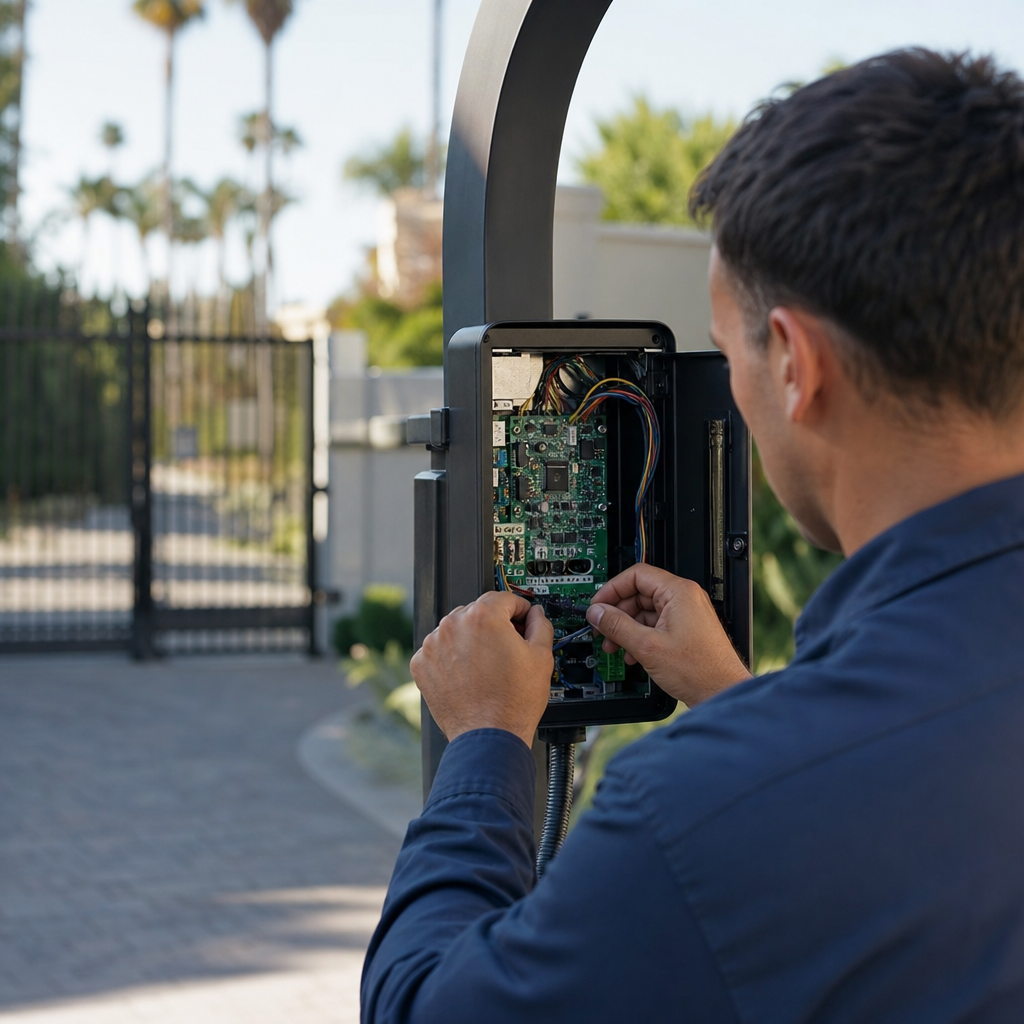
In high-traffic settings, entry speed dictates the safety and flow of the property perimeter. Optical scanners force drivers to stop and align a credential with an optical sensor. If alignment is missed, processing slows down and creates entry delays.
Throughput Speed and Multi-Tag Processing
As noted by NIST, RFID technology supports high throughput, reading multiple credentials quickly. When applied to gate access control systems, according to specialists at Smart Choice Gate RepairLong Beach, the reader detects an oncoming credential without requiring a complete halt for optical alignment, supporting smoother traffic flow. Barcode readers, by contrast, process strictly one item at a time and require visual alignment.[2]
Windshield Tags vs Optical Stickers
RFID windshield tags and barcode stickers offer vastly different operational experiences. Passive RFID windshield tags can be placed inside the vehicle and read without direct optical exposure. Barcode decals require direct line of sight to the optical reader, making them dependent on clear physical alignment.
Evaluating Long-Term System Value
Initial equipment expenses tell only part of the story when evaluating access control hardware. While basic optical barcode systems may carry lower upfront hardware costs, the operational delays and queues associated with single-file line-of-sight scanning can impact overall workflow.
Credential Security
In access-control use cases, RFID credentials are generally harder to clone than visible barcodes, which can often be duplicated with a simple photograph or copy.[3]
Workflow Improvements
By preventing driveway gridlock and eliminating line-of-sight delays, RFID systems help maintain steady traffic flow, reducing vehicle backup at entry points, an advantage often highlighted by Smart Choice Gate RepairLong Beach.
Frequently Asked Questions
What is the difference between an RFID gate reader and a barcode scanner?
An RFID gate reader uses radio waves to read data from vehicle tags automatically without requiring line of sight. An optical barcode scanner requires direct visual alignment between the scanner lens and a physical barcode or screen.
Which access control system is more secure for gated communities: RFID or barcode?
In access-control use cases, RFID credentials are generally harder to clone than visible barcodes, which can be easily duplicated with a photograph.
Can barcode scanners read without line of sight?
No. Barcode scanners require an unobstructed optical line of sight to decode credentials, whereas RFID systems communicate via radio waves and do not require optical alignment.
How does RFID improve gate throughput?
RFID supports higher throughput and multi-tag reads, allowing vehicles to verify access without stopping for manual optical alignment, thereby reducing vehicle queues.
Need rfid gate reader vs barcode scanner?
We’re available now — call for a fast, free estimate.
Sources
- Comparison of Reading Times of RFID-Tagged and … – pubmed.ncbi.nlm.nih.gov (2024)
- RFID Technology in Forensic Evidence Management: An Assessment of Barriers, Benefits, and Costs – nvlpubs.nist.gov
- Improving warehouse inventory management through RFID … – calhoun.nps.edu (2007)
- Shayne Pidding RFID Cost-Benefit – RAMP RFID – ramprfid.com (2044)
- Economies’ Horizons – pdfs.semanticscholar.org
Related reading: Comparing Rfid Based Gate Control System Options – 10% Off & Free Estimate – Same-Day Service
Related reading: Rfid Gate Control Pros and Cons | 10% Off & Free Estimate | Same-Day Service
Related reading: Rfid Based Gate Control System Reviews | Call Now-10% Off | Same-Day Service | Free Estimate
Frequently Asked Questions
How do weather conditions affect RFID gate readers compared to barcode scanners?
Barcode scanners are susceptible to optical interference from heavy rain, morning fog, dirt buildup, and direct sunlight glare on lenses or screens. RFID systems operate on radio frequencies that easily penetrate inclement weather and tinted glass. Smart Choice Gate Repair Long Beach properly tunes and positions RFID antennas to maintain dependable read ranges in all environmental conditions.
Can an existing automated gate support both an RFID reader and a barcode scanner simultaneously?
Yes, property managers can deploy a hybrid configuration using multi-relay access controllers that support both technologies. This setup allows permanent residents or fleet drivers to enter swiftly via long-range RFID tags while visitors scan temporary barcode passes at a pedestal. Smart Choice Gate Repair Long Beach integrates dual-credential setups to streamline traffic without compromising perimeter security.
What is involved in retrofitting an existing gate system from barcode scanning to RFID?
Retrofitting typically involves mounting an RFID reader antenna near the approach lane, connecting it to the existing gate operator controller, and distributing vehicle tags. Smart Choice Gate Repair Long Beach offers on-site assessments to evaluate existing wiring, pedestal positions, and loop detectors, ensuring a seamless upgrade without unnecessary hardware replacement.
About the author
 |
Rachel Lin Rachel Lin is a former property management consultant with over six years of experience managing residential and commercial facilities in Southern California. She holds a BA in Business Administration from California State University, Long Beach. Her writing focuses on practical solutions for property security and access control, with a specialized interest in automated gate systems and emergency repair protocols. |