
Quick Summary
RFID gate control systems eliminate driveway bottlenecks and manual access friction by establishing fast, automated radio communication between vehicle transponders and roadside reader antennas. As detailed by Smart Choice Gate Repair Long Beach, the system operates through a sequence where the reader powers the tag via RF backscatter, decodes its unique credential, and directs the controller to validate permissions and actuate the motor. Property owners will understand how to select between active and passive tags, navigate physical obstacles like coated windshields, and retrofit existing gate openers with secure, hands-free hardware.
How Does RFID Gate Control Work for Fast Driveway Access
If you want to know how RFID gate control works, the process centers on radio communication between an authorized vehicle credential and a mounted reader antenna. When a car approaches the entry lane, the reader detects the credential, sends its unique ID to a controller, and the controller signals the gate to open only after verifying authorization. Drivers get reliable, hands-free access without digging around for physical remotes or rolling down windows to punch numbers into a keypad.[1]
Below is a breakdown of how this signal sequence functions, what hardware makes it work, and how real-world environmental factors affect daily performance.
What You Need to Know: How RFID Gate Systems Automate Property Entry
How RFID gate systems automate property entry in brief: An RFID vehicle gate system follows a verified access pattern: the reader reads the vehicle tag ID, the access controller checks authorization against its database, and the gate opens once access is approved.[2]
Radio frequency identification eliminates the bottlenecks caused by traditional access methods. Instead of waiting at a standstill, the system detects approaching vehicles, verifying credentials and opening the gate before the car reaches the threshold.[4]
Core Components: Tags, Antennas, and Controllers
Every RFID gate access setup relies on three primary hardware pieces:
- Transponder Tags: Windshield decals, headlamp stickers, or rearview mirror tags containing a microchip and miniature antenna programmed with a unique identifier.
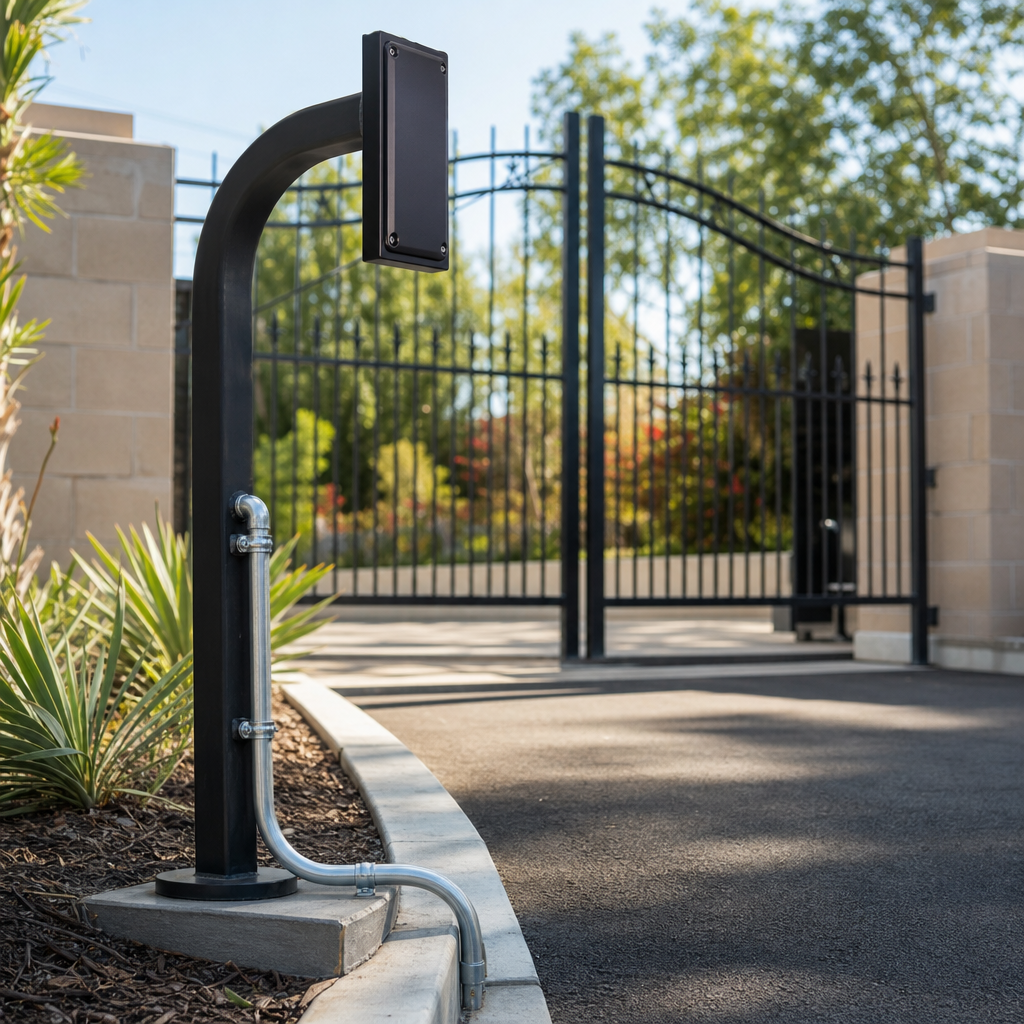
- RF Reader Antennas: Weatherproof roadside units that project an interrogation field across the driveway lane to read passing tags.
- Access Controller Boards: The processing unit that stores user permissions, evaluates tag IDs, and activates the gate operator upon authorization.
Key Takeaways: Fast, Hands-Free Security
Automating perimeter gates with RFID technology keeps traffic moving while maintaining access records. Different wireless standards govern RFID systems: ISO/IEC 14443 is a short-range standard (about 10 cm), while ISO/IEC 15693 provides longer range (up to about 1 m), alongside dedicated UHF protocols used for vehicle detection.[3]
What You’ll Need: Required Equipment for an RFID Gate Control System
As noted by Smart Choice Gate RepairLong Beach, a dependable installation requires properly matched transponders, an appropriately positioned antenna, an access controller, safety sensors, and protected low-voltage wiring. Each part plays an active role in detecting traffic and moving the gate safely.
Hardware Essentials Checklist
Choosing the correct transponder depends on your property layout and vehicle types. Coated windshields, vehicle height, and reader placement all dictate which tag format delivers reliable reads.
| Feature | Passive Windshield Sticker | Active Mirror Hangtag | Proximity Key Fob |
|---|---|---|---|
| Read Range Category | Standard vehicle detection range | Extended vehicle detection range | Short proximity range |
| Power Source | Energized by reader field | Internal battery | Energized by reader field |
| Best Application | Residential driveways and HOAs | Commercial fleets and logistics yards | Pedestrian side gates and pool enclosures |
Power and Low-Voltage Wiring Requirements
Consistent operation calls for stable low-voltage DC power supplies, shielded wiring runs inside protective conduit, surge protection, and safety loops connected directly into the controller inputs.
Step 1: The Reader Broadcasts an RF Interrogation Field
The access sequence begins at the approach lane. An antenna mounted near the driveway casts a directed radio beam across the path of incoming traffic.
Continuous Radio Frequency Scanning
In standard installations, this initial detection phase follows a specific sequence:
- Vehicle Presence Detection: In-ground detection loops or sensors detect an approaching vehicle and signal the antenna to scan.
- Carrier Wave Emission: The reader broadcasts an RF signal across the designated approach zone.
Detection Zone and Range Considerations
As emphasized by Smart Choice Gate RepairLong Beach, proper antenna alignment is essential. The reader must be positioned and tilted so the radio field covers only the designated entry lane. If the field spreads too wide, it risks reading tags from vehicles driving past or parked nearby.
Step 2: The Vehicle Transponder Tag Powers Up and Transmits Its ID
When the vehicle enters the scan zone, the tag receives power from the incoming radio waves. The tag’s internal chip powers up and returns its identification data back to the reader.
Passive Backscatter Communication
Most residential and community gate installations use passive windshield tags because they require no internal battery and provide low-maintenance operation. The tag’s micro-antenna absorbs RF energy emitted by the reader, powers the chip, and modulates the reflected signal to return its data.[5]
Active vs. Passive Tag Response Mechanics
Passive tags handle standard residential and community driveways. Active tags carry their own internal batteries and broadcast stronger signals for wide industrial gates, commercial transport depots, and heavy equipment yards.
| Tag Architecture | Power Mechanism | Read Distance Category | Ideal Application |
|---|---|---|---|
| Passive RFID | RF Field Harvesting (Backscatter) | Standard approach range | Single-family homes and gated communities |
| Active Transponder | Internal Battery | Extended approach range | Commercial yards and distribution centers |
Step 3: The Reader Decodes and Transmits Data to the Access Controller
Need how does rfid gate control work?
We’re available now — call for a fast, free estimate.
Once the antenna receives the reflected signal, it decodes the tag’s unique ID and transmits the data to the access controller.
Data Transmission to the Controller
The reader sends the credential data to the main gate controller over secure, standard communication wiring lines connecting the roadside equipment to the control panel.
Step 4: The Access Controller Validates Credentials Against the Database
The controller acts as the central brain. Upon receiving the credential data, it checks the unique tag ID against its internal user database to verify permissions.
Permission Checks, Schedules, and Audit Logging
Before triggering the gate, the controller evaluates several conditions:
- Identity Verification: The controller confirms the tag is active and assigned to an authorized user.
- Rule Logic: The board checks custom schedules, ensuring the credential is valid for the current time, day, or entry lane.
- Event Logging: The controller logs the entry event with a timestamp, user name, and tag ID for administrative records.
Step 5: The Gate Motor Actuates to Grant Property Entry
Once the controller verifies authorization, it sends an activation signal to the gate operator, instructing the drive motor to open the swing, slide, or barrier arm.
Safety Sensors and Auto-Close Cycles
Automated gate systems incorporate safety sensors and detection loops to monitor the roadway while the gate is moving. If a vehicle or pedestrian is detected in the path, the gate holds its position or reverses. Once the vehicle clears the safety area, a timer closes the gate automatically.
Environmental and Physical Factors Affecting Read Range
Environmental and physical factors can influence RFID read ranges. Moisture, physical obstructions, and specialty vehicle glass can attenuate signal strength if not accounted for during installation.
Moisture and Metallized Windshields
High moisture levels and modern automotive windshields containing metallic heat-reflective or acoustic coatings can reduce signal reception for internal tags.
To maintain reliable performance:
- Use Weatherproof Enclosures: Protect controller boards and wiring in weather-rated enclosures to safeguard electronic components from moisture.
- Select Exterior Tags: If vehicles have metallic windshield glass, mount exterior-rated transponders on the front bumper or headlamp housing to maintain an unobstructed path.
- Calibrate Detection Loops: Adjust loop detectors according to site conditions to ensure consistent vehicle detection.
Frequently Asked Questions About RFID Gate Control Systems
RFID gate control provides hands-free convenience while doing away with misplaced remotes and slow keypad lines. Here are answers to common questions about retrofitting and performance.
Can an RFID reader be added to an existing gate opener?
Yes. As explained by Smart Choice Gate RepairLong Beach, standalone RFID readers connect directly to standard input terminals on most gate operators, allowing you to add hands-free access without replacing your existing motor.
How secure are RFID gate credentials compared to keypads?
RFID tags offer significantly better security than keypads. Fixed PIN codes are easily shared, creating security vulnerabilities. RFID credentials use unique identification numbers, and lost or retired tags can be deactivated instantly in the management software.
How far away can an RFID gate reader detect a vehicle tag?
Read ranges vary by tag type and antenna setup. Standard passive tags provide standard driveway-range detection, while active tags with internal batteries achieve longer detection ranges suitable for larger commercial entry lanes.
Need how does rfid gate control work?
We’re available now — call for a fast, free estimate.
Sources
- Securing the Spectrum That Powers Global RAIN RFID – therainalliance.org (2028)
- Access Control Market Size, Share, Trends & Research Report, 2031 – mordorintelligence.com (2031)
- RFID Access Control System Market Research Report 2034 – dataintelo.com (2034)
- [PDF] RFID Based Campus Management System: Access Control System – ijream.org (2017)
- IoT Based RFID Gate Automation System – ijettjournal.org (2016)
Related reading: Guide to Choosing Rfid Gate Entry Systems | Call Now-10% Off | Same-Day Service | Free Estimate
Related reading: Comparing Rfid Based Gate Control System Options – 10% Off & Free Estimate – Same-Day Service
Related reading: Rfid Gate Control Pros and Cons | 10% Off & Free Estimate | Same-Day Service
Frequently Asked Questions
What causes an RFID gate reader to fail to detect a vehicle windshield tag?
Detection failures are commonly caused by metallized UV coatings, heated windshield elements, or improper reader antenna alignment that blocks the RF signal. Smart Choice Gate Repair Long Beach resolves these signal obstacles by repositioning the reader beam or switching to exterior-grade headlamp tags.
What should you do if an authorized RFID gate tag is lost or stolen?
System administrators can instantly deactivate the specific credential's unique serial number within the access controller database, preventing unauthorized property entry without affecting other users. High-frequency and UHF encrypted transponders also stop unauthorized cloning attempts.
How do you prevent an RFID gate reader from accidentally scanning cars in adjacent lanes?
Cross-reads are prevented by calibrating directional antennas to narrow coverage patterns and integrating in-ground presence loops that only trigger the reader when a vehicle is directly in front of the gate. Smart Choice Gate Repair Long Beach fine-tunes these detection zones to ensure adjacent traffic never opens the wrong gate.
About the author
 |
David Wallace David Wallace is a security systems specialist with over 10 years of experience in access control and gate automation. He holds a BS in Electrical Engineering from California State University, Long Beach, and has extensive experience designing and implementing secure entry solutions for both residential and commercial properties. David specializes in troubleshooting complex gate systems and providing practical advice on maintaining property security. |