
Quick Summary
This article explains the technology behind RFID gate access, detailing how wireless radio-frequency handshakes between vehicle transponders and reader antennas eliminate driveway bottlenecks and physical access vulnerabilities. Smart Choice Gate Repair Long Beach demonstrates how integrating passive tags, directional interrogators, and access controllers provides seamless entry while retrofitting easily onto existing swing, slide, or overhead gate motors. Readers will understand system architecture, safety loop integration, and the functional differences between active and passive setups to make informed decisions when consulting Smart Choice Gate Repair Long Beach for gate installations or repairs.
The Technology Behind RFID Gate Access for Fast Entry
Understanding the technology behind rfid gate access starts with looking at how radio frequency communication clears driveway bottlenecks. Instead of stopping to enter a code on a keypad or fumbling with a handheld clicker, a vehicle equipped with a transponder can roll toward the gate, trigger an authentication handshake, and pull straight through. Security and access control is a major application area for RFID technology, with specialists like Smart Choice Gate RepairLong Beach using smart cards and contactless credentials to serve everything from private residential communities to high-traffic commercial distribution centers.[1]
At Smart Choice Gate Repair Long Beach, we install, retrofit, and service automated gate systems across Long Beach and surrounding areas like Signal Hill, Belmont Shore, and Seal Beach. Proper antenna positioning, relay configuration, and secure enclosures ensure your gate opens reliably every single time. Contact Smart Choice Gate Repair Long Beach to schedule an estimate or discuss an upgrade.
How RFID Gate Access Systems Work
Overview: RFID gate systems use radio waves to identify approaching vehicles or pedestrians without physical contact. An interrogator antenna sends out an electromagnetic search signal. When a registered tag passes within range, it transmits its unique code back to the antenna. The access controller checks that code against an authorized database and triggers the gate motor to cycle open.[2]
Authentication Sequence
To understand how rfid gate access works on a practical level, follow the quick handshake that happens as a vehicle approaches:[5]
- Field Generation: The gate reader antenna emits an electromagnetic field across the approach lane.
- Signal Transmission: As the vehicle enters the detection zone, the tag receives energy from the field and transmits its credential data back to the reader.
- Data Verification: The reader captures this transmission and passes the credential data to the gate controller.
- Relay Trigger: The controller verifies permissions. If the credential is active, it closes a relay that signals the gate operator motor to run.
Key Benefits for Residential and Commercial Gates
Deploying radio-frequency systems on perimeter gates eliminates common physical vulnerabilities. Mechanical keypads wear out, keys can be copied, and remote clickers frequently suffer from dead batteries or lost signals. Proximity readers manage foot traffic at side gates and pool enclosures, while vehicle readers handle driveway entry lanes. Because credential databases sit in local or cloud-based controllers, property managers can revoke lost tags immediately without needing to re-key locks or reset shared entry codes.
Core Architecture: Readers, Transponders, and Controller Relays
An rfid gate access control system depends on three primary hardware components working in sync: the transponder on the vehicle, the antenna interrogator at the curb, and the access controller wired to the gate motor.[3]
RFID Transponders: Windshield Tags, Headlamp Stickers, and Key Fobs
Driveway gate installations commonly rely on passive tags. These credentials contain no onboard battery. Instead, they feature an antenna attached to an integrated circuit. When placed on a vehicle windshield or headlamp, the tag remains dormant until it enters the reader’s RF zone.
Vehicle composition can impact tag performance. Certain windshields with specialized coatings may obstruct radio signals. In these cases, exterior headlamp tags or front-license-plate transponders can be used to achieve reliable credential reads.
The RFID Interrogator and Antenna Array
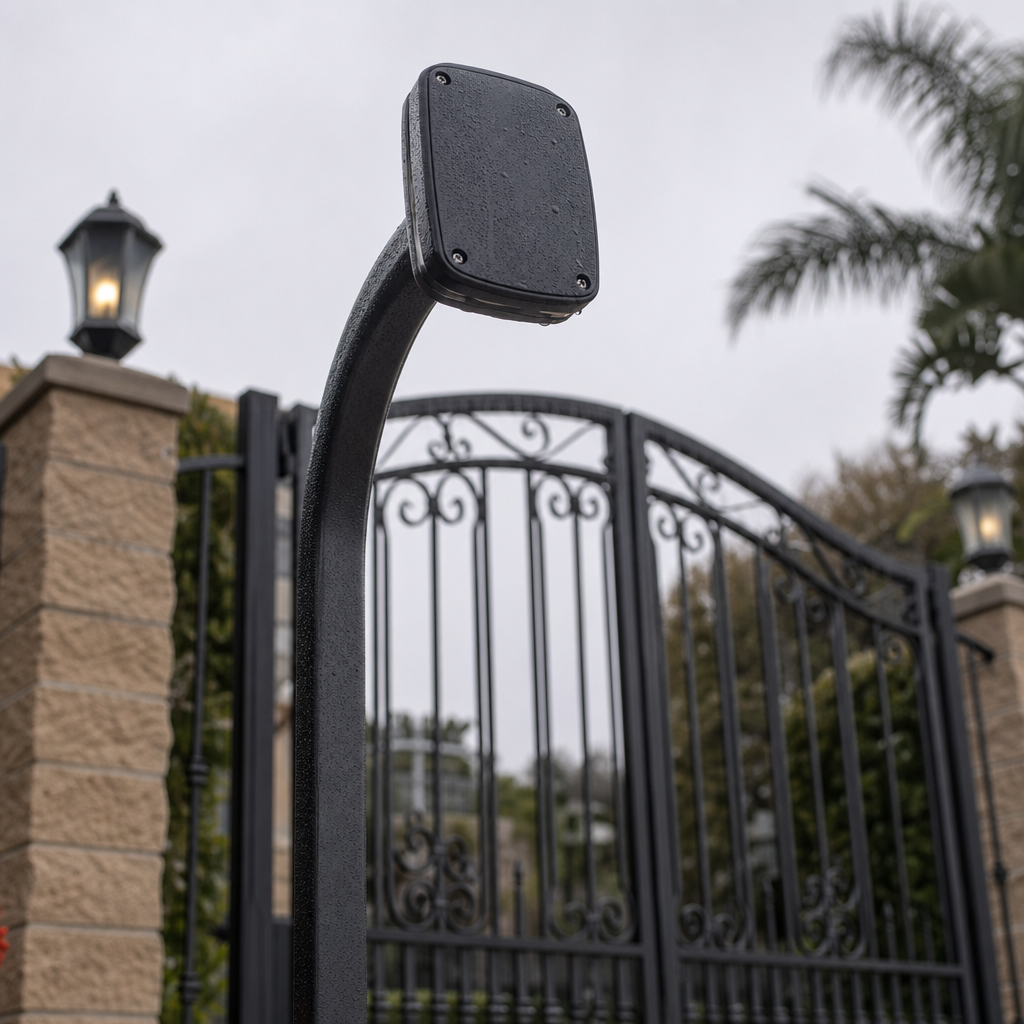
The interrogator houses both the RF transceiver and the directional antenna. Directional antennas concentrate the beam into a defined path toward approaching vehicles. This focused pattern helps prevent reads from vehicles driving by in adjacent traffic lanes.
Proper placement, routine maintenance, and protective enclosures help shield reader hardware from outdoor exposure and prevent avoidable system interruptions.
The Controller Interface
The reader itself does not decide whether a vehicle is allowed in; it simply captures the tag number. The raw data moves through a hardwired connection to the controller:
- Protocol Transmission: The reader translates the radio signal into standard security communication protocols, such as Wiegand or OSDP (Open Supervised Device Protocol).
- Permission Lookup: The controller checks the tag data against its internal memory.
- Motor Activation: If validated, the controller fires an output relay, sending a low-voltage pulse to the gate operator open terminals.
Signal issues often stem from electrical interference rather than software glitches. Long, unshielded cable runs parallel to high-voltage motor lines can introduce electrical noise, disrupting data communication before it reaches the controller board.
Active vs Passive RFID Gate Systems: System Comparison
Need the technology behind rfid gate access?
We’re available now — call for a fast, free estimate.
Choosing between active and passive RFID gate systems depends on site layout, required detection distance, and operational demands.
| Feature | Passive RFID Systems | Active RFID Systems |
|---|---|---|
| Power Source | Reader electromagnetic field | Internal tag battery |
| Tag Maintenance | No battery replacements required | Periodic battery replacement required |
| Common Applications | Driveway gates, smart cards, pedestrian side gates | Extended-range vehicle entry, fleet depots |
Read Range Expectations: Proximity vs Vehicle Entry
For standard residential driveways and gated communities, passive RFID vehicle gate entry provides a practical balance of convenience and low maintenance. Tags do not require battery replacements, and vehicles are detected early enough for the gate operator to open as the vehicle approaches. Active systems can be utilized when specialized site layouts require extended detection distances.
Retrofitting RFID Technology to Existing Driveway and Security Gates
According to Smart Choice Gate RepairLong Beach, property owners do not need to replace their entire gate to add RFID capabilities. Most existing swing, slide, and overhead gate openers can easily accept an external access reader.
Controller and Motor Compatibility
Upgrading an existing operator involves integrating the reader into the current control setup:
- Mounting the Reader: Position the antenna on an offset pedestal or support post, angled toward the incoming lane to match the expected vehicle approach.
- Power Supply Setup: Provide clean, regulated DC power. Sharing unconditioned power directly from a heavy-draw gate motor can cause voltage drops that reset the reader during motor startup.
- Terminal Connection: Connect the access controller relay outputs directly to the gate operator open-command terminals (commonly labeled “START,” “OPEN,” or “RADIO”).
- Credential Programming: Enter authorized transponder numbers into the management interface.
Safety Loop and Sensor Integration
Vehicle access readers must always be paired with safety devices. Because the RFID antenna may detect a vehicle before it reaches the opening, safety loops, shadow loops, and photo eyes are essential. These sensors prevent the gate from closing on a vehicle if it pauses in the swing path or stops above the driveway threshold.
Frequently Asked Questions About RFID Gate Access Technology
Can RFID gate tags be cloned or spoofed?
Access control systems rely on secure credentials and credential management databases to authenticate vehicles. Authorized tag IDs are registered in the controller database, allowing property managers to easily deactivate or revoke individual credentials to prevent unauthorized entry.[4]
What happens to RFID gate readers during a power outage?
Because RFID readers rely on low-voltage electricity, they turn off during a general utility outage unless connected to a battery backup system. Most modern automated gate operators feature integrated DC battery backup systems that supply reserve power to both the motor and access accessories. Mechanical key releases or bypass locks allow manual operation if reserve power is unavailable.
How much does it cost to install an RFID vehicle gate system?
Hardware and installation pricing depends on site requirements, including the reader model, controller hardware, mounting infrastructure, wiring needs, and whether the installation covers single or multi-lane access.
How quickly can a malfunctioning RFID gate system be repaired?
Most RFID gate reader issues, ranging from misaligned antennas to wiring or relay board faults, can be diagnosed and repaired promptly by an experienced gate technician from Smart Choice Gate RepairLong Beach carrying standard diagnostic tools and replacement parts.
Need the technology behind rfid gate access?
We’re available now — call for a fast, free estimate.
Sources
- RFID Access Control Market Research Report 2034 – marketintelo.com (2034)
- RFID Market Size | Growth Forecast To 2035 – marketgrowthreports.com (2035)
- RFID Access Control System Market Research Report 2034 – dataintelo.com (2034)
- Card-Based Access Control Systems Market Research Report 2034 – dataintelo.com (2034)
- The Convergence of RFID and Access Control in Modern … – rfidjournal.com
Related reading: Comparing Rfid Based Gate Control System Options – 10% Off & Free Estimate – Same-Day Service
Related reading: Rfid Gate Control Pros and Cons | 10% Off & Free Estimate | Same-Day Service
Related reading: Rfid Gate Reader Vs Barcode Scanner | Call Now-10% Off | Same-Day Service | Free Estimate
Frequently Asked Questions
How do metallic windshields or UV tints affect RFID gate access tags?
Metallic coatings and athermic windshield glass can attenuate passive radio-frequency signals, preventing interior windshield tags from registering. Smart Choice Gate Repair Long Beach resolves this issue by installing exterior headlamp stickers or front-license-plate transponders that maintain direct line-of-sight communication with the reader antenna.
Can an RFID gate reader be integrated alongside visitor keypads or telephone entry systems?
Yes, modern gate controllers easily support multiple access devices wired to the same motor terminals. Smart Choice Gate Repair Long Beach integrates RFID readers alongside existing keypads, intercoms, or mobile app systems using standard Wiegand or OSDP protocols for complete property management.
What read range should property owners expect from passive vehicle RFID gate systems?
Passive UHF vehicle transponders typically deliver an effective read range of 10 to 25 feet depending on antenna strength, vehicle approach angle, and lane geometry. Smart Choice Gate Repair Long Beach calibrates reader angles and pedestal placement to ensure the authentication sequence triggers early enough for smooth, continuous drive-through entry.
About the author
 |
David Wallace David Wallace is a security systems specialist with over 10 years of experience in access control and gate automation. He holds a BS in Electrical Engineering from California State University, Long Beach, and has extensive experience designing and implementing secure entry solutions for both residential and commercial properties. David specializes in troubleshooting complex gate systems and providing practical advice on maintaining property security. |