
Quick Summary
An RFID-based gate control system utilizes wireless radio frequency communication between vehicle credentials and reader antennas to provide secure, hands-free entry automation. Technical specialists at Smart Choice Gate Repair Long Beach emphasize that dependable operation requires selecting the appropriate frequency band, aligning directional antennas accurately, and accounting for physical factors like windshield attenuation. Property owners will learn how RFID access controllers seamlessly integrate into existing automated gate operators and can request a free consultation and upfront estimate for professional installation or repair.
What Is an RFID Based Gate Control System?
An RFID-based gate control system uses radio frequency identification to identify authorized vehicles or personnel, verify their credentials, and trigger an automated gate mechanism. Instead of requiring drivers to roll down a window, punch in a keypad code, or present a physical key, the system uses wireless signals exchanged between an RFID tag (transceiver) and an RFID reader antenna mounted near the driveway or entryway.[2]
While generic explanations treat these setups as simple plug-and-play electronics, as noted by Smart Choice Gate RepairLong Beach, a dependable RFID gate installation requires careful tuning. Real-world performance can depend on factors such as antenna alignment, operating frequencies, potential signal obstruction from vehicle windshields, and environmental resistance against moisture and weathering.[4]
How Does an RFID Gate Access Control System Work?
At an operational level, an RFID gate opener functions through a four-step communication loop between hardware at the gate post and the credential on the vehicle:
- Interrogation Signal Emission: The RFID reader continuously broadcasts a low-power radio frequency field across a designated read zone.
- Tag Excitation and Transmission: When an authorized vehicle approaches, the RFID tag enters the radio field. Passive tags capture enough energy from the reader’s signal to power their internal microchip and transmit their unique identification number (UID) back to the reader. Active (battery-assisted) tags transmit their own signal over longer distances.
- Data Verification: The reader captures the tag’s signal and relays the credential data to the access control unit (ACU) or system controller. The controller compares the tag ID against an internal database of permitted users, schedules, and security tiers.
- Gate Trigger: If the credential is valid, the controller closes an electrical relay, sending an open command directly to the gate operator motor. If the tag is invalid or outside permitted hours, the gate remains closed and logs an unauthorized access attempt.
Primary Components of an RFID Automated Gate System
Official security baselines, such as the New Zealand Information Security Manual (NZISM), categorize access control hardware into three primary layers: a reader, a transceiver at each control point, and a controller that operates the physical locks or gate barriers.[3]
1. The RFID Transceiver (Tags and Credentials)
The transceiver contains an internal chip and an antenna coil that holds encrypted identification data. In driveway gate applications, these take several forms:
- Windshield Stickers: Passive tags applied to the inside of a front windshield, designed to break if removed to prevent tag sharing.
- Headlamp Tags: Exterior-mounted passive tags used on vehicles where certain windshield glass types may reduce radio signals.
- Rearview Mirror Hangtags: Portable credentials that can be transferred between fleet or family vehicles.
- Key Fobs and Proximity Badges: Used primarily for secondary pedestrian gates or side-yard entrances.
2. The RFID Reader and Antennas
The reader operates at the perimeter to capture signals from incoming transceivers. In standard vehicle lane configurations, an external directional antenna focuses the RF energy specifically toward the approach lane to avoid triggering adjacent gates or capturing cross-traffic signals. According to ISO/IEC 18046-4 standards, high-frequency interrogators can also use multiple coordinated antennas placed on opposite sides of a passageway to ensure reliable signal capture across wide transit points.
3. The Access Controller and Gate Operator
The access controller acts as the central brain. It receives raw credential inputs via standard communication protocols (such as Wiegand or OSDP) and determines entry rights. Once approved, it triggers the gate operator (the mechanical motor, gearbox, and arm assembly that physically moves the slide, swing, or barrier gate).
RFID Frequency Bands and Range Characteristics
Need what is a rfid based gate control system?
We’re available now — call for a fast, free estimate.
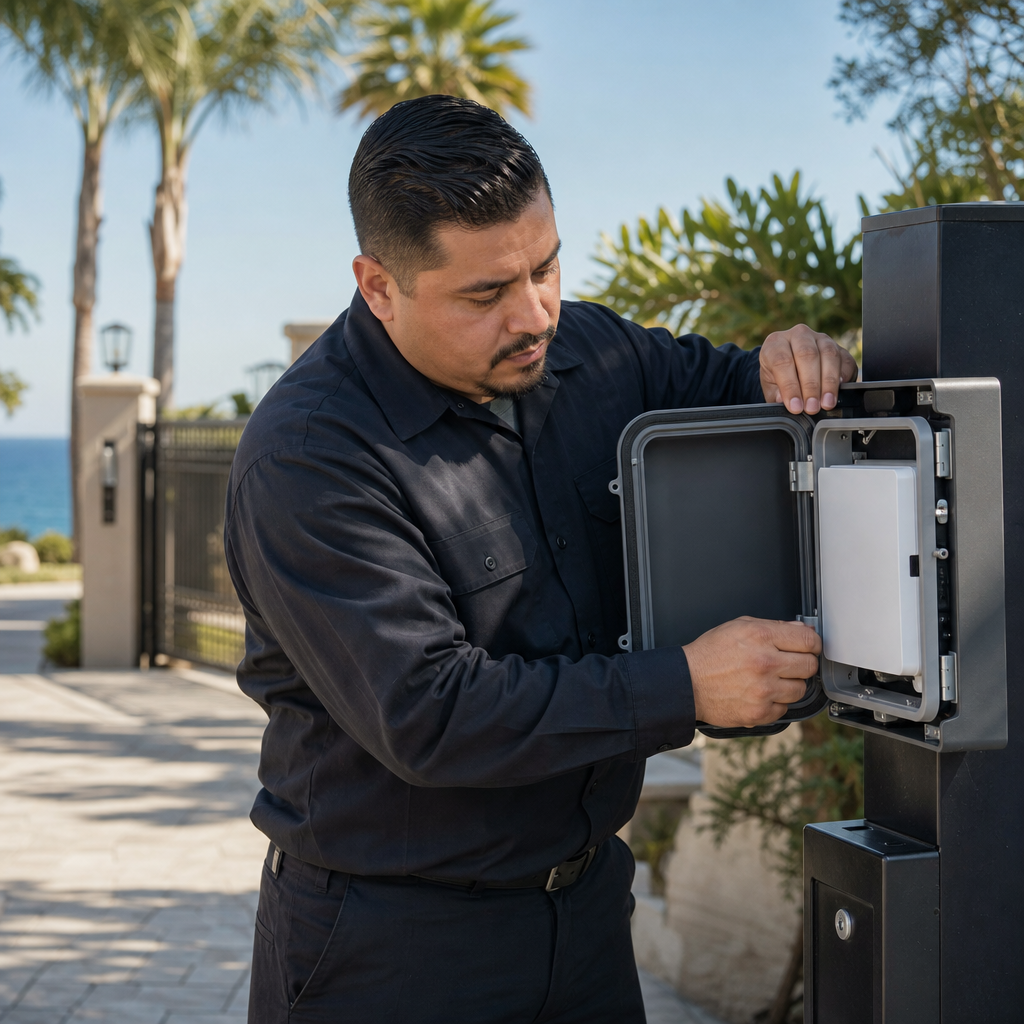
RFID systems operate across three primary frequency bands. Selecting the correct band determines read range, data transfer speed, and how well the signal penetrates physical obstacles.
| Frequency Band | Standard Frequency | Effective Read Range | Common Gate Applications |
|---|---|---|---|
| Low Frequency (LF) | 125 kHz | 2 cm to 10 cm | Pedestrian side gates, pool enclosures, key fobs |
| High Frequency (HF) | 13.56 MHz (ISO/IEC 14443 & 15693) | Up to 10 cm (14443) / Up to 50 cm (15693) | Encrypted smart cards, secure residential entry |
| Ultra-High Frequency (UHF) | 860 to 960 MHz | Up to 10 metres | Hands-free vehicle access, commercial truck gates |
As outlined in NZISM guidance, traditional low-frequency badge systems operate at 125 kHz for short-range tap entry. Newer high-frequency smart cards run at 13.56 MHz, governed by standards like ISO/IEC 14443 (short range up to 10 cm) and ISO/IEC 15693 (vicinity cards readable up to 50 cm). For automated vehicle gates where drivers should not have to stop, UHF can be used for longer-range vehicle access applications, operating between 860 and 960 MHz and allowing read ranges of up to 10 metres.[5]
Real-World Implementation: Avoiding Common RFID Gate Failures
Property owners often run into reliability problems when generic RFID hardware is installed without accounting for site-specific physical factors:
- Windshield Attenuation: Certain vehicle windshields with specialized or metallic coatings can attenuate RF signals. Tag placement adjustments, such as using exterior tags or designated windshield cutout zones, can help maintain reliable communication.
- Antenna Angle and Cross-Read Interference: Improper antenna alignment on multi-lane driveways can cause unintended reads across adjacent lanes. Careful antenna positioning and alignment help confine the detection zone to the intended vehicle queue.
- Environmental Wear: According to field specialists at Smart Choice Gate RepairLong Beach, outdoor installations exposed to moisture, humidity, or salt air require weather-resistant enclosures and appropriate outdoor hardware to protect sensitive electronics and connections.
- Ground and Post Stability: Ground settling in softer soils can cause gate support posts and reader pedestals to shift over time, which may misalign directional antennas and degrade read performance.
System Integration: Adding RFID to Existing Automatic Gates
An RFID access control system does not require replacing your existing gate motor. Modern commercial and residential gate operators include auxiliary dry-contact control inputs designed for external triggers. An RFID controller wires directly into these inputs alongside existing safety loops, photo eyes, and emergency override systems.[1]
During an integration by Smart Choice Gate RepairLong Beach, technicians connect the RFID controller’s output relay to the gate operator’s open command terminal, power the unit using a dedicated low-voltage transformer or solar-charged battery backup, and program authorized credentials via local software or a cloud-managed portal.
Frequently Asked Questions
Can RFID access control be integrated into an existing automatic gate?
Yes. As long as your existing gate operator has standard auxiliary or open-input terminals, an RFID reader and controller can be wired directly into the system without altering the mechanical motor.
What is the difference between active and passive RFID gate tags?
Passive RFID tags do not have an internal battery. They draw power directly from the reader’s radio waves, making them inexpensive, maintenance-free, and long-lasting. Active RFID tags contain their own battery source, which allows them to broadcast stronger signals over greater distances; active RFID tags can reach much farther, often tens to hundreds of meters, though they require periodic battery replacement.
What is the typical read range for RFID vehicle gate access systems?
UHF vehicle systems typically achieve reliable read ranges between 4 and 10 metres. This allows the gate operator enough time to swing or slide open before the car reaches the entrance, eliminating the need for the driver to stop completely.
How much does an RFID gate control system cost to install?
Equipment and installation costs depend on the number of lanes, frequency type, hardware selected, and existing site infrastructure. Overall costs vary depending on project-specific requirements, not including the gate operator motor itself.
Need what is a rfid based gate control system?
We’re available now — call for a fast, free estimate.
Sources
- RFID Access Control Market Research Report 2033 – dataintelo.com (2033)
- RFID Access Control System Market Research Report 2034 – dataintelo.com (2034)
- RFID Access Control Card Readers Market Report – dataintelo.com (2034)
- RFID Door Locks Market Report | Global Forecast From 2025 To … – dataintelo.com (2034)
- Design and Construction of an Automatic Security System of a Door Using RFID Technology – ijser.org (2000)
Related reading: Is an Rfid Gate Control System Right for My Business | Call Now-10% Off | Same-Day Service | Free Estimate
Related reading: Comparing Rfid Based Gate Control System Options – 10% Off & Free Estimate – Same-Day Service
Related reading: Rfid Gate Control Pros and Cons | 10% Off & Free Estimate | Same-Day Service
Frequently Asked Questions
How do you revoke or replace an RFID gate credential if a tag is lost or stolen?
Administrators can immediately disable lost tags through the access controller software or cloud dashboard without needing to rekey or modify hardware. Smart Choice Gate Repair Long Beach configures secure management systems that allow property owners to instantly assign replacement credentials and prevent unauthorized entry.
What should you do if metallic windshield tint blocks the RFID gate signal?
Vehicles with metallized glass or UV-filtering windshields can use exterior-mounted headlamp tags or transceivers placed in designated windshield cutout zones. Technicians at Smart Choice Gate Repair Long Beach can evaluate signal obstruction during an upfront estimate and calibrate external hardware for seamless detection.
How does an RFID-based gate control system continue operating during a power outage?
Most commercial and residential setups connect to dedicated battery backups or solar power assemblies to keep the RFID reader, controller, and motor operational off-grid. Smart Choice Gate Repair Long Beach installs and services low-voltage battery backups alongside mechanical key overrides to guarantee continuous property access.
About the author
 |
David Wallace David Wallace is a security systems specialist with over 10 years of experience in access control and gate automation. He holds a BS in Electrical Engineering from California State University, Long Beach, and has extensive experience designing and implementing secure entry solutions for both residential and commercial properties. David specializes in troubleshooting complex gate systems and providing practical advice on maintaining property security. |